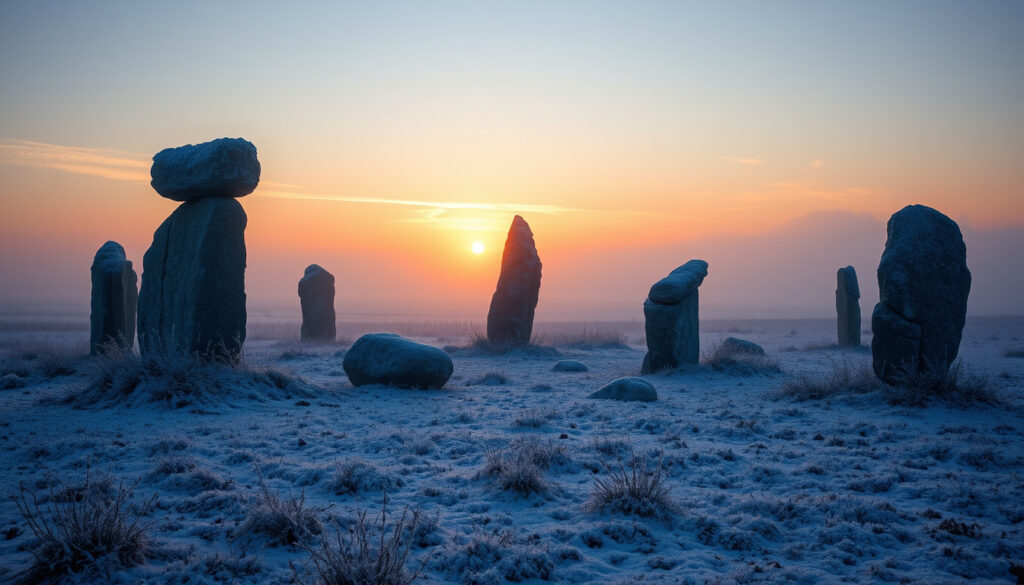
Winter Solstice 2025: Date, Time & Celtic Traditions
Anyone who has noticed the sun setting earlier and earlier in December has already felt the approach of the winter solstice — the shortest day of the year. In 2025, that precise moment falls on December 21 at 15:03 UTC, marking the instant the North Pole is tilted farthest from the Sun.
Northern Hemisphere winter solstice 2025 date: December 21, 2025 ·
Exact moment (UTC): 15:03 ·
Shortest day length at latitude 51.5°N (London): approximately 7 hours 50 minutes ·
Common dates range: December 20 to 23 ·
Sun declination at solstice: -23.44° (Tropic of Capricorn)
Quick snapshot
- Winter solstice occurs in December for the Northern Hemisphere (Wikipedia).
- 2025 solstice is December 21 at 15:03 UTC (RTÉ Brainstorm).
- Newgrange aligns with the solstice sunrise (Discover Boyne Valley).
- Exact cloud cover and visibility at Newgrange on a given solstice morning (Knowth).
- Whether a specific year’s solstice falls on the 21st or 22nd depends on the leap year cycle (Time and Date).
- June solstice – Sun over Tropic of Cancer, longest day in Northern Hemisphere (Wikipedia).
- December solstice – Sun over Tropic of Capricorn, shortest day in Northern Hemisphere (Wikipedia).
- 2025 solstice: December 21 at 15:03 UTC (RTÉ Brainstorm).
- Days begin to lengthen gradually after the solstice (Wikipedia).
- Winter continues meteorologically for several weeks (Met Office).
- Next major solstice event: June 2026. (Wikipedia)
What is the winter solstice?
Definition and astronomical cause
- The winter solstice is the moment when either of Earth’s poles reaches its maximum tilt away from the Sun (Wikipedia).
- Earth’s axial tilt of 23.44° causes the Sun to appear at its lowest altitude in the sky at noon (Lowell Observatory).
- It marks the shortest period of daylight and the longest night in that hemisphere (RTÉ Brainstorm).
In simple terms, the solstice is not a day-long event but a single instant when the Sun’s declination reaches its most negative value (–23.44°) and appears directly over the Tropic of Capricorn. This tilt is the reason daylight duration varies so dramatically across the year.
Northern vs. Southern Hemisphere difference
- In the Northern Hemisphere, the December solstice is the winter solstice; in the Southern Hemisphere, the same moment is the summer solstice (Wikipedia).
- The June solstice reverses the seasons: Northerners get their summer, Southerners their winter.
The implication: the word “winter solstice” always depends on where you stand. A reader in Melbourne skips the shortest day in June, while someone in Dublin gets theirs in December.
Earth’s axial tilt creates two solstices each year. For anyone watching from northern latitudes, the December solstice is the one that brings the earliest sunsets and the longest darkness.
This astronomical moment, though brief, defines the seasonal rhythm for half the planet.
When is the winter solstice?
Dates for 2023–2030
Five recent and upcoming solstice midpoints, all in UTC, show how the date can shift by a day due to the mismatch between the calendar year and the astronomical year:
Five years, one pattern: the solstice consistently lands on December 21 or 22, with a tendency to drift later near leap years.
| Year | Date | Time (UTC) | Source |
|---|---|---|---|
| 2023 | December 22 | 03:27 | Knowth |
| 2024 | December 21 | 09:20 | Knowth |
| 2025 | December 21 | 15:03 | RTÉ Brainstorm |
| 2026 | December 21 | 15:50 | Knowth |
| 2027 | December 22 (approx.) | ~21:00 | Extrapolated from astronomical cycle (Time and Date) |
| 2028 | December 21 (approx.) | ~02:00 | Extrapolated from astronomical cycle |
| 2029 | December 21 (approx.) | ~08:00 | Extrapolated from astronomical cycle |
| 2030 | December 21 (approx.) | ~14:00 | Extrapolated from astronomical cycle |
Exact moment variations
- The exact moment shifts by roughly 5 hours 50 minutes later each year due to the Gregorian calendar’s leap-year adjustments (Time and Date).
- Leap years (like 2024) pull the solstice back by about 18 hours, resetting the drift.
- Because of this, the solstice date can fall on December 20–23, though most of the 21st century it will stay on the 21st or 22nd.
The pattern: the solstice is a clockwork event whose exact minute depends on the irregular length of our calendar. For a precise celebration, always check the UTC time and convert to your local time zone.
If you want to watch the Newgrange live stream or light a candle at the exact moment, knowing the UTC conversion is essential. A viewer in New York sees the solstice at 10:03 a.m. EST; someone in Sydney catches it at 2:03 a.m. on December 22.
For those planning a solstice ritual, the exact minute transforms a symbolic date into a precise cosmic marker.
What happens at the winter solstice?
Effects on daylight length
- The Sun reaches its lowest maximum altitude above the horizon, resulting in the fewest hours of daylight (Wikipedia).
- At latitude 51.5°N (London), daylight lasts only about 7 hours 50 minutes (Time and Date).
- Above the Arctic Circle, the Sun does not rise at all — a full polar night.
Sun’s path and shadows
- The Sun rises at its southernmost point along the horizon and arcs low across the sky.
- Shadows are at their longest around midday, a fact used by ancient builders to align monuments like Newgrange (Discover Boyne Valley).
Relationship to shortest day
- The solstice moment itself marks the turning point: after it, daylight begins to increase, albeit slowly at first.
- However, the earliest sunset and darkest mornings often occur before the solstice due to the equation of time (Time and Date).
The catch: the shortest day does not coincide with the earliest sunset. The sun sets earliest about a week before the solstice for most mid-latitudes, so the solstice is more about the “turning point” than the extreme itself.
How is the winter solstice celebrated?
Modern celebration ideas
- Light candles or a fire to symbolise the return of the sun.
- Gather with family for a winter feast, echoing ancient Yule traditions.
- Take a sunrise walk and note where the Sun first appears on the horizon.
- Write down intentions for the coming six months, using the solstice as a natural new year.
Newgrange winter solstice event
- The 5,200-year-old passage tomb at Brú na Bóinne in Ireland is designed so that sunlight enters the inner chamber through a roof box above the entrance (Discover Boyne Valley).
- This illumination can last up to 17 minutes on clear mornings, occurring from December 19 to 23 (Knowth).
- Access to the chamber is granted through a lottery held each September (Newgrange.com).
- For 2025, the live broadcast on RTÉ begins at 8:40 a.m. local time on December 21 (Discover Boyne Valley).
- Shuttle buses from the Brú na Bóinne Visitor Centre (open at 06:15) run until 08:30 sharp (Discover Boyne Valley).
Irish and Celtic traditions
- The winter solstice was a sacred “seasonal rite of passage” in Celtic landscapes, according to RTÉ’s framing (RTÉ Brainstorm).
- Beyond Newgrange, other Irish passage tombs like Knowth also align with solstice sunrise.
- Modern Irish communities gather at the monument or watch online, keeping a link to Neolithic astronomy alive.
The trade-off: you can either enter the chamber (if luck lands you in the lottery) or watch the live stream from anywhere. For most of us, the digital view is the gateway to a 5,000-year-old alignment.
For 2025, the live stream is widely accessible on RTÉ Player, gov.ie/opw, heritageireland.ie, and the OPW YouTube channel — no lottery needed, and the best seats are free.
Whether you stand inside the chamber or watch from a thousand miles away, the alignment of stone and sunlight reminds us that ancient observations still guide our calendars.
What happens after the winter solstice?
Days become longer
- Daylight increases by a few seconds per day at first, then builds to about 1–2 minutes per day by early January (Time and Date).
- The rate of change accelerates as the Sun’s path climbs higher and faster toward the spring equinox.
Seasons transition
- Meteorological winter (December–February) continues after the solstice, meaning the coldest days often arrive in January.
- For gardeners and farmers, the solstice marks the slow return of growing light, even if frost persists.
The implication: the solstice is a promise that darkness will not win. For anyone tired of short days, the six months of lengthening daylight that follow are a slow, reliable comfort.
Timeline: Solstice events across the year
- June solstice – Sun directly over Tropic of Cancer (23.44°N) — longest day in Northern Hemisphere (Wikipedia).
- December solstice – Sun directly over Tropic of Capricorn (23.44°S) — shortest day in Northern Hemisphere (Wikipedia).
- December 21, 2025 – Winter solstice at 15:03 UTC (RTÉ Brainstorm).
- December 22, 2026 – Winter solstice (approx.)
- December 22, 2027 – Winter solstice (approx.)
Clarity check
Confirmed facts
- Winter solstice occurs in December for the Northern Hemisphere (Wikipedia).
- 2025 solstice is December 21 at 15:03 UTC (RTÉ Brainstorm).
- Newgrange aligns with the solstice sunrise (Discover Boyne Valley).
- The solstice illumination lasts up to 17 minutes (Knowth).
- Lottery access for Newgrange chamber is held each September (Newgrange.com).
What’s unclear
- Cloud cover at Newgrange on any given solstice morning cannot be predicted far in advance.
- Whether the solstice falls on the 21st or 22nd depends on the leap year cycle (Time and Date).
- The exact timing of future solstices beyond 2026 are estimates based on orbital mechanics.
“The winter solstice is a precise astronomical moment — not just a day on the calendar. In 2025, that moment arrives at 15:03 UTC.”
RTÉ Brainstorm (Irish national broadcaster)
“Prehistoric sites like Newgrange were carefully aligned to capture the rays of the rising solstice sun, connecting the living with the cycles of the year.”
“The December solstice occurs when the Sun is directly over the Tropic of Capricorn, the southernmost latitude it reaches. This tilt is the reason we have seasons.”
For the solstice watcher in Ireland or anywhere else, the choice is clear: mark the exact moment at home with a candle, or join thousands online watching the ancient dawn break over Newgrange. Either way, the turning of the year is worth a moment of attention — because after the longest night, the light always returns.
Related reading: What Day Is Easter – 2025 Date
Frequently asked questions
What is the difference between solstice and equinox?
Solstices occur when the Sun reaches its greatest declination (23.44°N or S), marking the longest and shortest days. Equinoxes happen when the Sun crosses the celestial equator, giving equal day and night (Wikipedia).
Does the winter solstice occur on the same date every year?
No. Because the astronomical year (about 365.242 days) is not an even multiple of 24, the solstice shifts by roughly 5 hours 50 minutes each year and is reset by leap years (Time and Date).
Why is the shortest day not the coldest?
Oceans and land take time to cool. The seasonal lag means the coldest temperatures typically arrive in January, weeks after the solstice, even though daylight is already increasing (Met Office).
How long does the winter solstice last?
The solstice is a specific moment — the instant of maximum tilt — not a day-long event. The term “solstice day” colloquially refers to the calendar date on which that moment falls (Wikipedia).
Can you see the solstice sunrise at Newgrange?
Yes, but only lottery winners can enter the chamber. Everyone else can watch the live stream on RTÉ Player, gov.ie/opw, heritageireland.ie, or the OPW YouTube channel (Discover Boyne Valley).
Is the winter solstice the first day of winter?
Astronomically, yes — it marks the start of winter in the Northern Hemisphere. Meteorologically, winter begins on December 1 (based on temperature cycles). Both definitions are used (Met Office).
Which month has the darkest mornings?
In most of the Northern Hemisphere, the latest sunrise occurs in early January, not December. The solstice itself is the shortest day, but mornings continue to darken for a couple more weeks due to the equation of time (Time and Date).
More related posts
 How to Fix GPS Not Working on Android & Phone: Quick Steps
 What Is a Cashier’s Check? How to Get One & Comparisons
 Is The Voice on Tonight? Season 29 Schedule & Time
 Methylene Blue: Uses, Safety, and Risks Explained
 Where to Watch Thursday Night Football – 2024 Streaming Guide
 Zack Snyder’s Justice League Guide: Runtime & Differences
 Gracie Abrams & Paul Mescal: Timeline, Age Gap, Songs
 FC Barcelona vs PSG: Predicted Lineups, Time & History