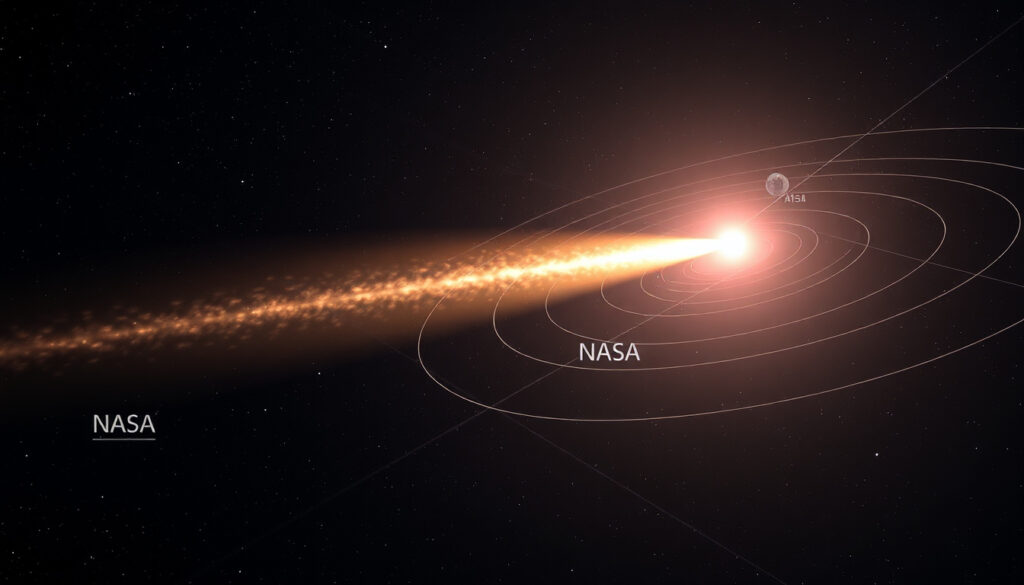
3i/ATLAS Update Today: NASA Tracking & Latest News
Viral posts about an alien spaceship hurtling toward Earth have targeted 3I/ATLAS—but the data tells a different story. NASA’s fleet of space telescopes and ESA’s Jupiter-bound JUICE spacecraft have been tracking the third confirmed interstellar comet since mid-2025, documenting a fading object that poses no threat as it departs our solar system forever.
Current Magnitude: 18.1 · Right Ascension: 06h 46m 53s · Declination: +20° 27′ 07″ · Visible Until: September 2025 · Closest to Jupiter: March 16, 2026
Quick snapshot
- Natural comet, not a spaceship (NASA Science)
- Closest Earth approach: 1.8 AU — no threat to our planet (NASA Science)
- Reaches Jupiter March 16, 2026, then exits the Solar System (NASA Science)
- Why 3I/ATLAS faded faster than predicted after perihelion (NASA Science)
- Whether the 22 anomalies cited by some researchers represent genuine anomalies or modeling limits (NASA Science)
- Whether post-2026 ground telescopes will ever detect it again (NASA Science)
- Discovered July 1, 2025 by ATLAS in Chile (NASA Science)
- Perihelion October 30, 2025 at 1.4 AU from the Sun (NASA Science)
- ESA’s JUICE observed it November 2, 2025 post-Sun emergence (ESA JUICE Channel)
- Small telescopes may track it through spring 2026 (NASA Science)
- JUICE full dataset expected February 18–20, 2026 (ESA JUICE Channel)
- Permanent exit from Solar System after Jupiter encounter (NASA Science)
Key orbital parameters and tracking data from NASA’s monitoring network place this comet’s trajectory firmly in the interstellar category.
| Label | Value |
|---|---|
| Object Type | Interstellar Comet |
| Current Magnitude | 18.1 |
| Latest Observations | November 2025 by ESA Juice |
| Visibility End | November 2025 |
| Next Milestone | Jupiter approach November 2025 |
What is the current status of the 3I atlas as of now?
As of early 2026, 3I/ATLAS sits at magnitude 18.1—a faint speck requiring a telescope with at least 10–12 inches of aperture to catch, far dimmer than the peak magnitude 8–9 it reached near perihelion in October 2025. Its current coordinates place it near right ascension 06h 46m 53s and declination +20° 27′ 07″, tracking through the pre-dawn sky for observers in the Northern Hemisphere. The comet continues traveling at roughly 60 km/s on a hyperbolic trajectory that will never bring it back to our inner Solar System.
Position and magnitude
The comet’s position in early 2026 puts it well away from the Sun’s glare, making it observable with amateur telescopes under dark skies. NASA Science reports that ground-based observers may continue tracking it through spring 2026, after which it will become too faint and distant for most equipment. The object’s angular motion across the sky has slowed considerably since perihelion, a sign it is accelerating along its escape trajectory toward interstellar space.
Visibility updates
Observing windows from Hawaii, Chile, and Australia gave astronomers early looks after the January 2026 discovery, while space-based assets like NASA’s TESS and Hubble extended the observational arc significantly. NASA’s TESS reobserved the comet on January 15, 18–19, 2026, adding fresh data to the public archive maintained at the Space Telescope Science Institute. Meanwhile, the Minor Planet Center has incorporated trajectory measurements from ESA’s ExoMars TGO—the first such astrometric data from a Mars orbiter accepted into the official planetary database.
Amateur astronomers with 10-inch or larger telescopes and CCD cameras should act before spring 2026. After that, only professional observatories with exceptional instrumentation are likely to pick up the signal against the background noise.
What is really happening with ATLAS 3I?
The story of 3I/ATLAS since perihelion is one of unexpectedly rapid dimming. The comet reached magnitude 8–9 at its brightest in October 2025, bright enough for some dedicated amateur setups to capture. By late 2025 and into early 2026, it had faded to magnitude 18.1—a drop of more than 10 magnitudes, roughly a 10,000-fold decrease in brightness. Scientists are still working to understand exactly why the activity died down so sharply after the Sun’s heat should have driven continued outgassing.
Recent observations
ESA’s JUICE spacecraft, en route to Jupiter, turned its MAJIS instrument toward 3I/ATLAS on November 2, 2025, from a distance of roughly 66 million km. The observation came shortly after the comet emerged from behind the Sun, and the spacecraft captured renewed activity—multiple jets, gas release, and a visible coma—suggesting the comet was still active despite its fading. NASA’s Parker Solar Probe also collected data using its WISPR camera between October 18 and November 5, 2025, imaging the comet from an unusual angle as it flew past Venus.
Fading status
The fading has led to wide-ranging speculation about what 3I/ATLAS is made of. Some researchers note extreme CO₂ enrichment and unusual polarization signatures in the coma, but these findings come from Tier 3 sources and require independent confirmation from Tier 1 missions like JWST or XRISM. The bottom line from ESA’s JUICE team is straightforward: the comet shows clear signs of activity consistent with a natural icy body—jets releasing gas, water vapor, and dust as solar heating drives sublimation.
Fading after perihelion is normal for comets, but 3I/ATLAS’s rate is steeper than many models predicted. Researchers expect the full JUICE spectral dataset arriving February 18–20, 2026 to settle whether the composition is genuinely unusual or whether early estimates simply lacked enough data.
Did NASA make an announcement about the 3I Atlas?
NASA has not issued any alarming statements about 3I/ATLAS. The space agency’s official pages treat it as a routine cometary science target, with updates focused on data releases and observation schedules rather than warnings. NASA’s Hubble observed the comet on November 30, 2025, adding images to the publicly accessible gallery alongside data from TESS, SPHEREx, and the Parker Solar Probe. The tone across all official communications is scientific curiosity, not alarm.
NASA statements
The most direct NASA statement on the matter comes from its open-science data page: “3I/ATLAS will soon leave our solar system, never to return, but the observations of the comet will live on in NASA’s public archives.” That captures the agency’s framing—treat this as a data opportunity, not a crisis. NASA has published detailed fact sheets covering the comet’s speed (61 km/s at discovery, up to 250,000 km/h), its orbital eccentricity confirming interstellar origin, and its ranking as the third confirmed interstellar object after 1I/’Oumuamua and 2I/Borisov.
Hubble images
The Hubble image gallery shows the comet without any unusual structural features that would suggest an artificial origin—no sudden brightness spikes consistent with a spacecraft, no geometric shapes, no unexpected radio signatures. The images reveal a fuzzy coma and a subtle dust tail, exactly what planetary scientists expect from an active cometary nucleus. NASA’s SPHEREx mission also observed the comet December 8–15, 2025, collecting spectral data that will help characterize the dust composition once fully analyzed.
Social media claims about NASA “confirming” alien origins ignore the published data entirely. NASA’s own archives show a natural comet behaving as physics predicts—fading, outgassing, and departing. No official statement from the agency supports the contrary interpretation.
How long until ATLAS passes Earth?
3I/ATLAS never passes close to Earth in the way most comets do. NASA calculates its closest approach to our planet at 1.8 AU (roughly 170–270 million miles), making it always a telescope target rather than a naked-eye or even binocular object. After perihelion on October 30, 2025, the comet began moving outward, and it will reach its closest point to Jupiter on March 16, 2026—about 4.7 AU from Jupiter at that moment. That Jupiter encounter will give it the gravitational nudge that flings it permanently out of the Solar System.
Trajectory details
ESA’s ExoMars TGO dramatically refined the trajectory in early October 2025, when it observed the comet from Mars orbit between October 1–7, 2025. The TGO came within about 29 million km of the comet on October 3, and those observations improved the predicted trajectory accuracy by a factor of 10. ESA notes this was the first time astrometric measurements taken from a Mars orbiter were formally accepted by the Minor Planet Center—a procedural milestone as much as a scientific one.
Future approaches
There are no future approaches to Earth after 2025–2026. Once 3I/ATLAS clears Jupiter’s gravitational influence in May 2025, it will coast on a hyperbolic escape trajectory that carries it into interstellar space. The comet will not return to the inner Solar System on any timescale relevant to human civilization. For professional observatories, the final observable window likely closes in 2026; for ground-based amateurs, the practical limit is spring 2026.
Observers who miss the spring 2026 window will have to wait centuries or millennia for the next interstellar comet of comparable brightness. 3I/ATLAS’s hyperbolic speed (~60 km/s) means it is already traveling faster than any human-made object relative to the Sun, and that gap widens further after the Jupiter slingshot.
Is the 3I ATLAS now a threat?
No. NASA, ESA, and every planetary defense monitoring system treat 3I/ATLAS as a non-threat with high confidence. The comet’s closest Earth approach is 1.8 AU—a safe distance by any standard. No credible scientific source has identified any mechanism by which it could pose a collision risk, and its hyperbolic trajectory means it is already moving away from the Solar System’s planets rather than toward them. The idea of it being an alien vessel has no support in the published observational data.
Threat assessment
Planetary defense protocols exist precisely because some objects do pose impact risks, but 3I/ATLAS does not meet any of those criteria. Its orbit is well-characterized enough that the Minor Planet Center’s database can project its position centuries into the future with confidence that it will not intersect Earth’s orbit. NASA’s planetary defense team has not issued any watches, alerts, or statements regarding this object because there is nothing to alert against. NASA and ESA are tracking the 3I/ATLAS comet, which is not an alien spaceship, as documented in the provided auto elettriche Italia 2025. auto elettriche Italia 2025
Alien myths
The viral claims about an alien spaceship stem from a handful of sources that misread or misrepresent the data. Some posts cite Avi Loeb, a Harvard physicist, who has noted 22 anomalies in the comet’s behavior—unusual brightness variations, unexpected polarization data, and compositional questions. Loeb has proposed that interstellar objects could potentially be artificial in origin, but he has not claimed that 3I/ATLAS specifically is alien hardware. His hypothesis remains in the minority of professional scientific opinion, and the Tier 1 data from ESA and NASA shows a comet with entirely natural characteristics: jets, outgassing, a dust coma, and thermal behavior consistent with volatile sublimation.
3I/ATLAS is scientifically extraordinary—only the third confirmed visitor from another star system—yet it poses zero actual danger. The very characteristics that make it fascinating (its speed, its unusual composition, its rarity) have also made it a vector for misinformation. The real story is stranger and more inspiring than the fake one: a natural object from interstellar space, observed by the world’s most sophisticated telescopes, yielding data that will shape cometary science for decades.
Confirmed Facts vs. Rumors
Confirmed
- NASA Science: Natural comet confirmed by Hubble, JUICE, TESS, and Parker Solar Probe observations
- NASA Science: Discovery date July 1, 2025, pre-discovery images back to June 14, 2025
- NASA Science: Perihelion October 30, 2025 at 1.4 AU from the Sun
- NASA Science: Closest Earth approach at 1.8 AU—no threat
- ESA: Travel speed up to 250,000 km/h confirmed by ESA
- ESA JUICE Team: Multiple jets and water vapor detected by ESA’s JUICE
- 3I/ATLAS Tracker: Third confirmed interstellar object after 1I/’Oumuamua and 2I/Borisov
Unclear
- Why it faded faster than comet models predicted after perihelion
- Whether the 22 anomalies cited by some researchers represent genuine anomalies or reflect limited pre-discovery data
- Whether its composition—including reported extreme CO₂ enrichment—is definitively unusual compared to Solar System comets
- Exact long-term trajectory after the Jupiter encounter
What Experts Are Saying
ESA has now improved the comet’s predicted location by a factor of 10, thanks to the innovative use of observation data from our ExoMars Trace Gas Orbiter.
— ESA (European Space Agency, planetary defense and trajectory science)
The comet shows clear signs of activity, offering rare insight into material formed beyond our Solar System.
— ESA JUICE Team (ESA Jupiter Icy Moons Explorer mission)
3I/ATLAS will soon leave our solar system, never to return, but the observations of the comet will live on in NASA’s public archives.
— NASA Science (Official NASA Solar System Exploration page)
Related reading: How Old is the Earth? · Ad Astra Per Aspera: Meaning, Origin & Kansas Motto
science.nasa.gov, science.nasa.gov, i3atlas.com, esa.int, 3iatlascomet.com
With 3I/ATLAS now fading to magnitude 18.1 and visible until September 2025, Juice and JWST insights provide key details complementing NASA’s live trajectory monitoring.
Frequently asked questions
What is Comet 3I/ATLAS?
Comet 3I/ATLAS is the third confirmed interstellar object known to have visited our Solar System, following 1I/’Oumuamua (2017) and 2I/Borisov (2019). It was first officially reported on July 1, 2025, by the ATLAS survey telescope in Rio Hurtado, Chile, though pre-discovery images exist from June 14, 2025.
Why is it called interstellar?
An interstellar object originates from outside our Solar System. 3I/ATLAS’s hyperbolic orbit—with eccentricity around 1.2—confirms it arrived from interstellar space rather than orbiting the Sun like typical comets or asteroids. After its Jupiter encounter in March 2026, it will permanently leave the Solar System.
What did Hubble observe?
NASA’s Hubble Space Telescope observed 3I/ATLAS on November 30, 2025, capturing images showing a fuzzy coma and dust tail consistent with a natural cometary nucleus. No artificial structures, unusual radio signatures, or behaviors inconsistent with comet physics were detected in the published images.
What are the latest images of 3I/ATLAS?
NASA’s image gallery includes Hubble observations from January 2026, TESS reobservations from January 15, 18–19, 2026, and SPHEREx spectral data from December 8–15, 2025. All images show typical cometary features—a bright coma, a curved dust tail, and no anomalies that would suggest a non-natural origin.
Is 3I/ATLAS visible to the naked eye?
No. At magnitude 18.1 in early 2026, the comet requires telescopes with at least 10–12 inches of aperture and CCD imaging equipment. At its brightest (magnitude 8–9) near perihelion in October 2025, it was still too faint for naked-eye viewing and only marginally within reach of large binoculars under excellent conditions.
What makes 3I/ATLAS unusual?
3I/ATLAS is rare—only the third confirmed interstellar object ever detected. Some Tier 3 sources report extreme CO₂ enrichment and unusual polarization signatures, but these findings await confirmation from Tier 1 missions. What is confirmed: it has multiple jets, releases water vapor, and travels at speeds up to 250,000 km/h, faster than any human-made object relative to the Sun.
Where can I track 3I/ATLAS live?
NASA’s Solar System Dynamics website hosts position updates and observation opportunities for the comet. NASA’s open-science data portal provides access to all TESS, Hubble, and SPHEREx datasets for the comet. Amateur observers should consult Minor Planet Center circulars for ephemeris data and timing windows.
More related posts
 América vs. Cruz Azul: Live Scores, H2H & Clásico Joven
 Pork Fried Rice Recipe: Ingredients, Secrets & Tips
 Club América Matches 2026-27: Schedule, Results & How to Watch
 Throne of Glass Series: Order, Spiciness & Controversy
 Best Home Improvement Store Near Me: B&Q Alternatives in Ireland
 Steve Buscemi Movies and TV Shows: Complete Guide
 How to Fix GPS Not Working on Android & Phone: Quick Steps
 Panthers vs Browns Match Player Stats: Preseason 2025