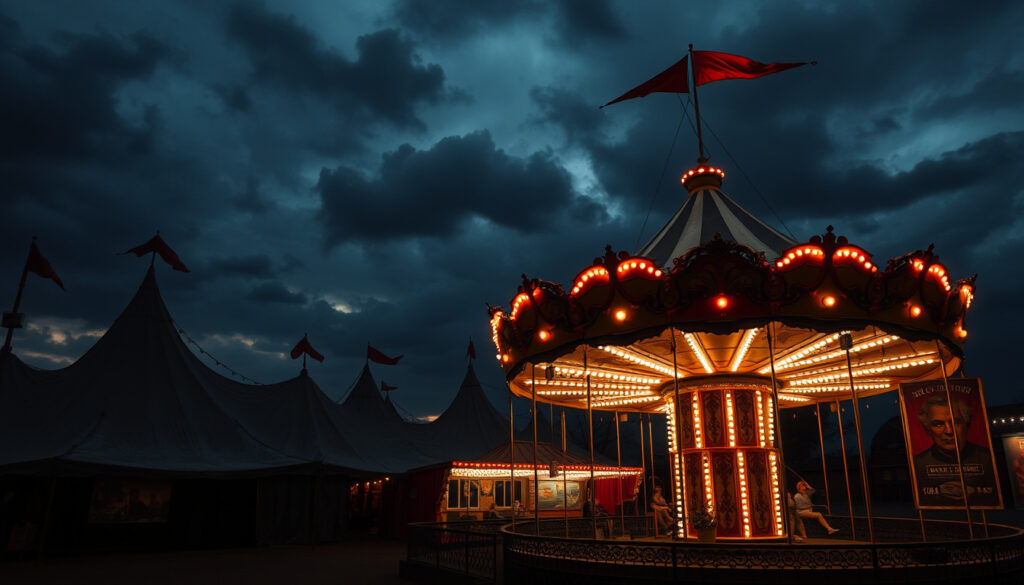
Something Wicked This Way Comes – Quote, Book and Cultural Legacy
Something Wicked This Way Comes: Quote, Book & Cultural Legacy
The phrase “something wicked this way comes” has woven itself into the fabric of English literature and popular culture. Originally spoken by a witch in Shakespeare’s seventeenth-century tragedy, the line gained renewed life through Ray Bradbury’s 1962 novel and its subsequent film adaptation. Understanding its journey reveals how a single couplet can transcend its original context to become a universal expression of foreboding.
While the line’s theatrical origins lie in a supernatural warning about approaching evil, Bradbury appropriated the phrase to explore temptation and innocence in American suburbia. This exploration examines both the Shakespearean source and the modern interpretations that have cemented the phrase in contemporary consciousness.
What Does ‘Something Wicked This Way Comes’ Mean and Where Is It From?
The phrase originates from William Shakespeare’s Macbeth, specifically Act 4, Scene 1, spoken by the Second Witch. The complete couplet reads: “By the pricking of my thumbs, / Something wicked this way comes.” The First Witch then responds with the matching line completing the rhyme.
In this context, the line carries supernatural weight. The “pricking of thumbs” refers to an old superstition—folk belief held that a tingling sensation in the thumb presaged approaching evil or supernatural events. When the witches sense this warning through their unnatural perception, they recognize that someone embodying malevolence approaches their gathering.
Scholars identify this moment as the announcement of Macbeth’s arrival at the witches’ cave. The dramatic purpose serves dual functions: foreshadowing the protagonist’s moral transformation and establishing the supernatural forces that will manipulate him throughout the tragedy. The witches, often interpreted as agents of chaos rather than evil creators themselves, recognize Macbeth as their kindred spirit in violence.
Many people assume Macbeth himself speaks these famous words. In reality, the Second Witch delivers the line while announcing Macbeth’s approach. The protagonist never vocalizes this particular phrase within the play.
The line’s power derives partly from its rhythmic construction. Shakespeare crafted the words as a rhyming couplet, setting the witches’ speech apart from the iambic pentameter used by human characters. This stylistic distinction reinforces the otherworldly nature of these figures and makes their pronouncements feel like prophecy rather than conversation.
Key Facts at a Glance
Essential Insights
- The Second Witch speaks the line to announce Macbeth’s arrival at their cave in Act 4, Scene 1
- “Pricking of thumbs” references an Elizabethan superstition about supernatural premonition
- The rhyming couplet structure distinguishes witch dialogue from human characters
- Shakespeare coined this phrase—it was not a pre-existing idiom
- The line directly precedes the witches’ confrontation with Macbeth, who has become a tyrannical murderer
- Modern usage often detaches the phrase from its Shakespearean context entirely
- The phrase entered popular culture primarily through Bradbury’s novel, not direct theatrical repetition
Quick Reference Table
| Element | Source | Key Details | Year |
|---|---|---|---|
| Famous line | Macbeth | Spoken by Second Witch, Act 4 Scene 1 | 1606 |
| Novel title | Ray Bradbury | Borrowed phrase, loosely themed | 1962 |
| Film adaptation | Disney | Directed by Jack Clayton | 1983 |
| Full couplet | Macbeth | Includes “by the pricking of my thumbs” | 1606 |
| Related phrase | Macbeth | “Double double toil and trouble” | 1606 |
| Cultural peak | Post-1962 | Bradbury novel cemented phrase in lexicon | 1962+ |
What Is Ray Bradbury’s Something Wicked This Way Comes About?
Ray Bradbury published his novel Ray Bradbury in 1962, borrowing Shakespeare’s phrase as a title while creating a story with minimal direct connection to the play. The novel functions as a dark fantasy exploring childhood terror, temptation, and the passage of time.
The narrative centers on two thirteen-year-old boys, Will Halloway and Jim Nightshade, living in a small Midwestern American town. When a mysterious carnival arrives in October 1964, the boys sense something fundamentally wrong beneath the surface entertainment. The carnival’s ringmaster, Mr. Dark—also called the Illustrated Man—possesses supernatural abilities and a sinister agenda.
The Carnival’s True Nature
Mr. Dark’s carnival operates on a principle of spiritual corruption. Residents who visit seeking fulfillment discover that fulfilling desires carries a terrible price. Those who desire youth find themselves trapped in mirrors; those craving beauty become carnival freaks. The mechanics of this corruption transform the carnival into a metaphor for moral compromise.
The antagonist offers citizens precisely what they lack—strength, vitality, attractiveness—but these gifts come shackled to slavery. The carnival’s performers include mechanical figures that move with unsettling precision, while supernatural beings like the Dust Witch enhance the atmosphere of malevolent magic.
The Battle Against Darkness
Opposing Mr. Dark stands Charles Halloway, Will’s father, who serves as the town’s librarian. Unlike the corrupted townspeople, Halloway recognizes the carnival’s true nature immediately. His age—sixty-three when the novel occurs—becomes his unexpected advantage. Halloway confronts mortality directly, understanding that the carnival’s promise of reversed aging masks an infernal trap.
The climactic confrontation occurs on the carnival’s carousel. This device can reverse aging, and Mr. Dark manipulates the mechanism to entrap victims. However, Halloway employs unconventional weapons: love for his son, genuine laughter, and the recognition that time’s passage, though painful, constitutes a fundamental aspect of human dignity.
Bradbury’s novel explores the tension between frozen perfection and organic growth. The carnival promises eternal youth but delivers spiritual death, while accepting mortality allows characters to experience genuine connection and meaning.
Central Themes
Several interconnected themes emerge throughout Bradbury’s narrative. First, temptation manifests as an irresistible force that reveals character. Those who yield to the carnival’s promises expose their deepest insecurities and desires. Second, the boundary between good and evil proves permeable—the novel suggests that ordinary people contain both capacities.
Nostalgia for childhood innocence pervades the text, expressed through Bradbury’s evocative depiction of small-town American life in the early 1960s. The arrival of the carnival disrupts this innocent world, forcing both young and old to confront uncomfortable truths about desire and mortality. The passage of time receives particular attention, with autumn serving as a symbolic season of transformation and reflection.
Redemption in Bradbury’s framework comes through human connection rather than power or escapism. Halloway’s willingness to age, to accept his eventual death, paradoxically gives him strength that Mr. Dark cannot overcome. This theme resonates with broader American concerns about youth culture and the fear of aging that characterized the post-war era.
Is There a Movie Adaptation of Something Wicked This Way Comes?
Disney released a film adaptation in 1983, directed by Jack Clayton. The production remained faithful to Bradbury’s source material, with Bradbury himself contributing to the screenplay. This involvement distinguished the adaptation from many Hollywood treatments of literary properties, ensuring thematic fidelity even as visual storytelling required certain modifications.
The cast featured Jason Robards as Charles Halloway, bringing gravitas and warmth to the librarian’s battle against supernatural evil. Jonathan Pryce portrayed Mr. Dark, delivering a performance that emphasized the antagonist’s predatory charm. Young actors Shawn and Vidal alternated in the roles of Will and Jim, capturing the boys’ curiosity and growing awareness of the carnival’s danger.
Visual and Atmospheric Elements
The film emphasized atmospheric horror over explicit violence, consistent with Disney’s family-oriented brand while respecting the source material’s darker elements. Visual effects brought the carnival’s supernatural elements to life, depicting the Dust Witch’s powers and the mechanical revelers with particular attention to eerie detail.
Bradbury provided poetic narration throughout the film, his distinctive voice guiding viewers through the autumnal landscape of memory and dread. This stylistic choice reinforced the novel’s emphasis on nostalgia and the bittersweet qualities of growing older.
The film achieved modest box office returns upon release but subsequently gained cult status among fans of atmospheric horror and Bradbury’s work. Its reputation has grown through home video and streaming platforms, with particular appreciation for its visual interpretation of the carnival’s nightmarish qualities.
The adaptation heightened the carnival’s role as a metaphor for moral temptation, reinforcing themes that resonated with 1980s audiences concerned with consumer culture and the seductions of easy gratification. Father-son bonding received increased attention in the visual medium, providing emotional anchor points for the supernatural narrative.
The Quote Beyond Shakespeare and Bradbury
Beyond the novel and its adaptation, the phrase “something wicked this way comes” has permeated modern culture. Television episodes, video games, music titles, and novel references employ the line to signal approaching danger or supernatural threat. This widespread usage often occurs without awareness of the Shakespearean original.
The phrase’s adaptability stems from its universal applicability. Any situation involving concealed malevolence approaching undetected fits the description. Horror genres particularly favor the expression, drawing on the original’s supernatural associations while freeing the phrase from specific theatrical context.
Timeline: From Elizabethan Stage to American Screens
- 1606 — Shakespeare’s Macbeth premieres, containing the famous line spoken by the Second Witch in Act 4, Scene 1
- 1962 — Ray Bradbury publishes Something Wicked This Way Comes, introducing the phrase to new generations
- 1983 — Disney releases the film adaptation directed by Jack Clayton, with Bradbury’s screenplay involvement
Established Facts and Persistent Uncertainties
| Established Information | Information Requiring Further Verification |
|---|---|
| The Second Witch speaks the line in Macbeth | Precise premiere date of the play remains debated among scholars |
| Bradbury’s novel was published in 1962 | Specific inspiration sources for Bradbury’s carnival concept |
| The Disney film was released in 1983 | Exact box office performance figures vary by source |
| The phrase is a Shakespearean coinage | Whether Bradbury consciously referenced Macbeth beyond the title |
| The film achieved cult status over time | Complete list of pop culture references using the phrase |
The Cultural Weight of Borrowed Phrases
The journey of “something wicked this way comes” illustrates how phrases migrate across media and centuries. Shakespeare coined the expression in 1606, but its current cultural ubiquity owes more to Bradbury’s 1962 novel than to theatrical tradition. This redistribution of linguistic inheritance occurs frequently in English literature, where older works provide vocabulary that subsequent creators reshape.
The phrase’s modern usage frequently ignores its theatrical origins entirely. Speakers invoke the line to describe any situation of concealed threat approaching, from political analysis to casual conversation about neighborhood developments. This semantic flexibility demonstrates the phrase’s structural portability—the warning imagery transcends its original supernatural context.
Bradbury’s choice to title his novel with this particular phrase reveals an instinct for evocative language that audiences would remember. The carnival at his story’s center embodies the same quality: attractive surfaces concealing corrupting depths. The borrowed phrase functions as both marketing and thematic statement, signaling darkness beneath apparent entertainment.
Primary Sources and Quotations
“By the pricking of my thumbs, / Something wicked this way comes.”
— Second Witch, Macbeth, Act 4, Scene 1, William Shakespeare
The carnival tempts residents with their deepest desires—youth, beauty, strength—but at the cost of their souls, trapping them in mirrors or as freaks.
— Something Wicked This Way Comes plot summary
The first quotation represents the phrase’s complete original form, embedded within its theatrical context. The witches’ speech patterns throughout Macbeth employ similar rhythmic structures, creating a distinctive supernatural voice that distinguishes their dialogue from human characters. Scholars note that this rhythmic quality contributes significantly to the phrase’s memorable nature and subsequent cultural persistence.
Summary
The phrase “something wicked this way comes” originated in Shakespeare’s Macbeth, where the Second Witch speaks it to herald the arrival of a morally corrupted protagonist. The line’s combination of supernatural premonition and rhythmic memorability made it suitable for subsequent cultural appropriation. Ray Bradbury’s 1962 novel adopted the phrase as its title, creating a dark fantasy about temptation and mortality that overshadowed the original theatrical context for most modern readers. The 1983 Disney film adaptation further solidified the phrase’s association with atmospheric horror, though the story shares no plot elements with Shakespeare’s tragedy. Today, the expression functions as a universal warning of concealed threat, used across media and contexts while remaining rooted in Elizabethan supernatural drama.
Frequently Asked Questions
What does ‘something wicked this way comes’ mean?
The phrase serves as a warning that something evil or dangerous is approaching. In its original Shakespearean context, it announced the arrival of someone embodying malevolence.
Who says ‘something wicked this way comes’ in Macbeth?
The Second Witch speaks these words in Act 4, Scene 1. She delivers the line as part of a rhyming couplet while announcing Macbeth’s approach to the witches’ gathering.
Is the phrase from a book before Shakespeare?
No evidence indicates the phrase existed before Shakespeare coined it. The expression appears to be his original creation, emerging from his distinctive combination of folk superstition and theatrical craft.
What is the connection between Shakespeare’s play and Bradbury’s novel?
Bradbury borrowed only the phrase as his title. The novel’s plot about a sinister carnival has no direct relationship with Shakespeare’s tragedy beyond sharing the borrowed expression.
What are the main themes in Bradbury’s novel?
The novel explores temptation, the passage of time, childhood innocence, and redemption through human connection. The carnival functions as a metaphor for desires that corrupt those who pursue them.
Is the 1983 film suitable for children?
The Disney film carries a PG rating and contains frightening imagery appropriate for older children and adults. Parents should preview content for younger viewers due to the atmospheric horror elements.
Why did Bradbury choose this particular title?
Bradbury was drawn to the phrase’s ominous rhythm and its suggestion of approaching darkness. He felt the expression captured his novel’s mood of autumnal dread without requiring explicit connection to Shakespeare’s work.
More related posts
 Academy Sports Credit Card: Apply, Rewards & Payments Guide
 FC Barcelona vs PSG: Predicted Lineups, Time & History
 The Peanut Butter Falcon: Worth Watching
 Pope John Paul I – 33-Day Reign and Death Mystery
 Christmas Vacation: Watch Guide, Quotes, and Age Rating
 USAA Auto Loan Rates: Current APR, Requirements & Calculator (2025)
 Best Microphones for Podcasting: Top Picks for 2024
 Washington Wizards vs 76ers Match Player Stats: Full Breakdown