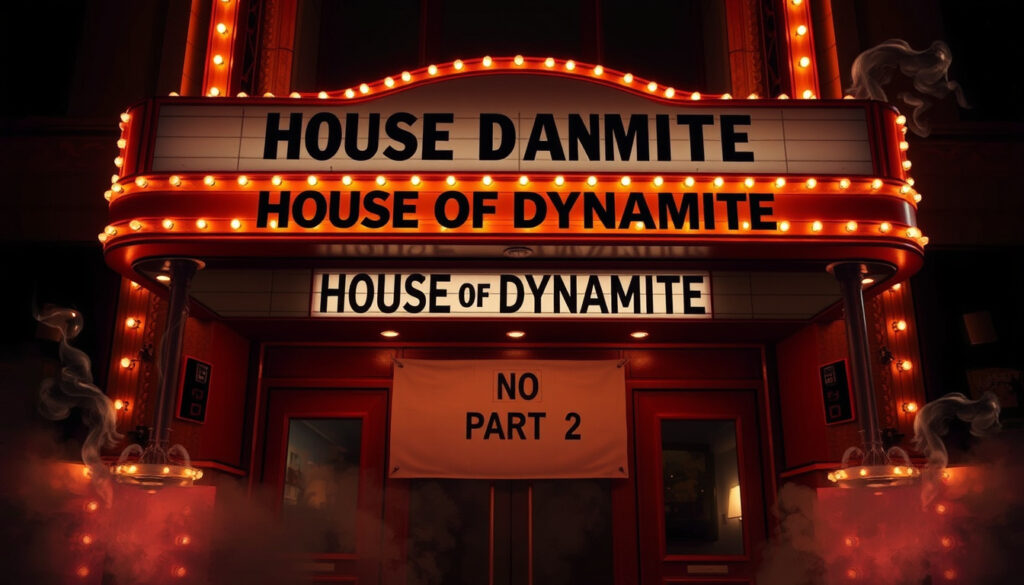
House of Dynamite Ending Explained: Why No Part 2
Few movies this year have sparked as much debate as the final moments of A House of Dynamite. You watch the President read a verification code, the missile reaches Chicago, and then — nothing. The credits roll. It is a choice that leaves viewers either furious or fascinated. This article breaks down what actually happens in that ending, why director Kathryn Bigelow made it that way, and what it means for a possible sequel.
Director: Kathryn Bigelow ·
Release Date: October 2025 (Netflix) ·
Ending Style: Ambiguous / Suspended apocalypse ·
Critical Reception: Polarizing (Forbes: “extremely frustrating”) ·
Platform: Netflix
Quick snapshot
- The missile’s origin is intentionally not revealed (Netflix Tudum’s official explainer).
- Both Ground-Based Interceptors fail — the first falls back, the second misses its target (Netflix Tudum).
- The film ends with the missile reaching Chicago and a cut to black (Netflix Tudum).
- Bigelow calls it “Eighteen minutes to decide the fate of the world and yet limited information” (Netflix Tudum).
- Whether the bomb actually detonates — viewers are split (Facebook discussion).
- If a sequel will ever be produced — no official word from Netflix (Netflix Tudum).
- The exact degree of audience satisfaction vs. frustration (TikTok user reactions).
- The entire crisis unfolds over 18 minutes of screen time (Netflix Tudum).
- The President reads his verification code just as the missile reaches Chicago (Netflix Tudum).
- No post-credits scene or after-the-event epilogue (Netflix Tudum).
- No sequel announced by Netflix (Netflix Tudum).
- The open ending leaves room for a Part 2, but it remains speculation (Reddit community discussion).
- Bigelow’s stated intention is that the ending stands alone as a statement (Elle interview).
Here are the core production details that frame the film’s controversial ending.
| Director | Kathryn Bigelow |
| Release Date | October 2025 |
| Platform | Netflix |
| Ending Type | Ambiguous / Suspended apocalypse |
| Key Character | Baker (protagonist) |
| Notable Death | Bodie dies |
Why Does House of Dynamite Have No Ending?
The most frequent question from viewers is why the film refuses to show what happens after the missile reaches Chicago. The answer lies in director Kathryn Bigelow’s deliberate creative choice — a radical act of narrative restraint that she has explained in multiple interviews.
The concept of a suspended apocalypse
- The apocalypse is neither averted nor resolved — it is suspended. The film’s final frame is the missile inbound, with no explosion shown (Netflix Tudum, streamer’s official editorial platform).
- Both interceptor systems fail. The first Ground-Based Interceptor “fails to detach properly and falls back to earth.” The second “reaches the missile but fails to connect” (Netflix Tudum).
- Bigelow wanted viewers to experience the same confusion and helplessness as the characters inside the bunker. She said, “We see into the halls of power, where highly competent individuals are confronted with confusion, chaos, and helplessness” (Netflix Tudum).
Director Kathryn Bigelow’s intention
- Bigelow has publicly called the ending “a radical act of cinematic restraint” (Elle, lifestyle magazine, quoting the director).
- She told Elle: “My question is, how do we take the dynamite out of the walls without tearing down the house?” — framing the film’s central theme as the impossibility of safely dismantling a threat everyone lives with (Elle).
- Forbes contributor Paul Tassi described the ending as “extremely frustrating,” comparing it to “a crashed plane on a runway” (Forbes, business media).
Bigelow’s refusal to show the bomb going off or not is the whole point: the audience is left in the same state of unbearable uncertainty that modern geopolitics creates every day. That is not a flaw — it is the message.
Is There a Part 2 of House of Dynamite?
Given the open ending, many viewers wonder whether Netflix plans a sequel to complete the story. Here is what the evidence shows so far.
Netflix’s official stance
- As of November 2025, Netflix has made no official announcement of a sequel (Netflix Tudum).
- The streaming platform has not renewed or greenlit a second part, and Bigelow has not confirmed any plans in interviews (Elle).
Storyline potential for continuation
- The ending’s ambiguity leaves room for a sequel, but the film’s thematic statement is self-contained. Bigelow designed it as a complete, if uncomfortable, experience (Netflix Tudum).
- Reddit users have speculated about a possible part 2, but the speculation is based on hope, not evidence (Reddit community discussion).
A sequel would contradict the entire purpose of the ending. The point is that there is no “right” resolution — adding a part 2 would turn a philosophical statement into a conventional story, which is the very thing Bigelow rejected.
What this means: For viewers waiting for Part 2, there is no reason to expect one. The film is intended as a one-off experiment in narrative discomfort. If a sequel ever comes, it will likely be from a different creative team — and would change the film’s legacy entirely.
Do People Like the Ending of House of Dynamite?
Audience reactions are sharply divided — some celebrate the boldness, others feel cheated. The split is not accidental; it is a direct result of the director’s choices.
Critical reviews (Forbes, Bulletin)
- Forbes writer Paul Tassi panned the ending as “extremely frustrating” and called the film a “crashed plane on a runway” (Forbes, business media).
- The Bulletin, an independent film analysis outlet, praised the ending as “a radical act of cinematic restraint” (The Bulletin, independent cultural analysis).
Audience reactions on Reddit and Facebook
- A Facebook discussion shows audience disagreement: one commenter insists the bomb did go off, while another argues that “whether it exploded is not the point” (Facebook user comments).
- Reddit users have described the ending as “deliberately ambiguous” and divisive (Reddit community discussion).
- A TikTok reaction video notes that viewers are split between frustration and awe, with many revisiting the ending to decode its meaning (TikTok user analysis).
Bigelow bet that making viewers uncomfortable was worth more than making them happy. The data suggests she succeeded at the discomfort — but the price is a large-scale viewer backlash that may hurt the film’s commercial legacy on Netflix.
The pattern: The more a viewer expects a traditional thriller payoff, the more they will hate this ending. The more they value conceptual filmmaking, the more they will admire it. There is no middle ground — and that was by design.
What Was the Ending to A House of Dynamite?
For those who need a clear breakdown of the final scene, here is exactly what happens — and what does not happen — in the last minutes of the film.
The final scene breakdown
- The third act is titled “A House Filled with Dynamite.” The film reaches its climax inside the Raven Rock bunker (Netflix Tudum).
- The President tries to call his wife, loses the signal, returns to the phone, and reads his verification code as the missile reaches Chicago (Netflix Tudum).
- The film cuts to black without showing the impact or aftermath, leaving the audience in the exact moment of impact (Netflix Tudum).
Key character fates (Baker, Bodie)
- Baker, the protagonist, reaches his child in a final, bittersweet moment (Netflix Tudum).
- Bodie dies. As a Reddit user summarized: “Bodie dies. Johnny knows Bodie dies. He lets Bodie pay the ultimate price” (Reddit user Giancarlo27).
- The film avoids showing the body hitting the ground, using omission to intensify the shock (Elle analysis).
Why this matters: Every specific plot point — the failed interceptors, the missing family connection, the president’s futile code — is designed to underscore that the characters are helpless. The ending shows their helplessness, not their heroism.
What Is the Point of A House of Dynamite?
Beyond the surface-level thriller, Bigelow’s film is a philosophical argument about modern anxiety and the impossibility of resolution in a nuclear age.
Thematic reading of the ambiguous ending
- The title is a metaphor: “a house of dynamite” is a civilization built on the threat of annihilation (Elle, lifestyle magazine, analysis).
- The film’s villain is not a country or a person — it is nuclear proliferation itself (Netflix Tudum, streamer’s official editorial platform).
- A YouTube analysis interprets the ending as emphasizing that responsibility and retaliation matter even without knowing the attacker’s identity (YouTube analysis, user-generated film criticism).
Bigelow’s explanation from interviews
- Bigelow told Netflix Tudum: “Eighteen minutes to decide the fate of the world and yet limited information [with] which to do so” (Netflix Tudum).
- She expanded in Elle: “We see into the halls of power, where highly competent individuals are confronted with confusion, chaos, and helplessness” (Elle).
- The ending forces viewers to sit with uncertainty — exactly the condition Bigelow wanted to create (Netflix Tudum).
By refusing to show the apocalypse, Bigelow makes it more terrifying. A concrete explosion would end the story; a suspended apocalypse never ends. The viewer carries it out of the theater. That is the point.
The trade-off: Viewers who want entertainment get frustration. Viewers who want truth about the human condition get an uncomfortable mirror. Bigelow chose the latter, and the box office may reflect that price.
Voices on the Ending
“Eighteen minutes to decide the fate of the world and yet limited information [with] which to do so.”
— Kathryn Bigelow, director, via Netflix Tudum
“It is a crashed plane on a runway — extremely frustrating.”
— Paul Tassi, Forbes contributor, via Forbes
“A radical act of cinematic restraint.”
— The Bulletin editorial, independent cultural analysis, via The Bulletin
“Bodie dies. Johnny knows Bodie dies. He lets Bodie pay the ultimate price.”
— Reddit user Giancarlo27, Reddit discussion
What makes A House of Dynamite unforgettable is not the explosion we never see, but the tension Bigelow forces us to live inside. For viewers who came for a conventional thriller, the experience is maddening. For those willing to sit with the film’s central question — how do we live in a house filled with dynamite? — the ending is a masterclass in cinematic courage. For Netflix subscribers looking for a satisfying resolution, Bigelow offers none: either embrace the ambiguity, or walk away frustrated. There is no third option, and that is exactly the point.
Frequently asked questions
Does the bomb go off in House of Dynamite?
The film cuts to black before showing the impact, so it is ambiguous. Netflix’s official explainer notes that the missile reaches Chicago but does not confirm an explosion (Netflix Tudum). Viewers remain divided on social media.
What happens to Baker at the end?
Baker gets through to his child in a final, bittersweet moment just before the missile arrives. His fate after the cut to black is unknown (Netflix Tudum).
Is there a post-credits scene?
No. The film ends abruptly with the cut to black and no additional footage after the credits (Netflix Tudum).
Why is the third act called “A House Filled with Dynamite”?
The title is a metaphor for a civilization built on the constant threat of annihilation. Bigelow chose it to underline the film’s theme of living with unresolved danger (Elle analysis).
How long is House of Dynamite?
The film runtime is approximately 102 minutes, with the final crisis unfolding over the last 18 minutes in real time (Netflix Tudum).
Where can I watch House of Dynamite?
The film is streaming exclusively on Netflix as of October 2025 (Netflix Tudum).
Is House of Dynamite based on a true story?
No. It is a fictional thriller, though Bigelow researched nuclear command procedures to ground the story in realism (Elle interview).
What is the meaning of the title?
The title refers to the idea that modern civilization is like a house packed with dynamite — a constant, invisible threat that could blow at any moment. Bigelow has said she wanted to explore how people live inside that uncertainty (Elle).
More related posts
 55 kg to lbs: How Many Pounds is 55 Kilograms
 How to Reduce Inflammation in the Body: Fast, Effective Tips
 Nivea vs Vaseline for Dry Skin: Which Is Better for Gen Z?
 América vs. Cruz Azul: Live Scores, H2H & Clásico Joven
 Xbox Series X Release Date: Launch Facts & Value in 2026
 What Is a Deductible? Definition, Examples, and How It Works
 Academy Sports Credit Card: Apply, Rewards & Payments Guide
 How Many Months in a Year? 12 Months & Their Origins