Freestyle Skiing at the 2026 Winter Olympics: Venue & Schedule
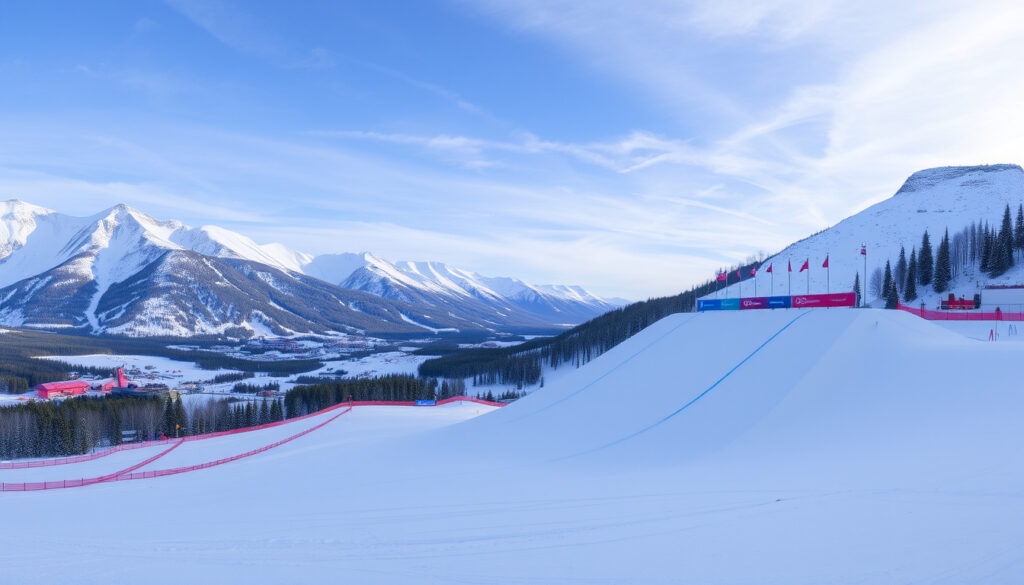
There’s something electric about watching the best freestyle skiers in the world throw themselves off a 50-metre jump or race head-to-head down a winding course. For Milano Cortina 2026, that electricity converges on Livigno Snow Park, a high-altitude venue purpose-built to host all 15 freestyle medal events.
Total freestyle skiing medal events in 2026: 15 ·
Host venue for all freestyle events: Livigno Snow Park ·
Dates of freestyle competition: 6–22 February 2026 ·
Number of disciplines (men + women): 10 (5 men, 5 women) plus 5 mixed/team rounds ·
New sport added for 2026: Ski mountaineering (mixed relay)
Quick snapshot
- Big Air (men/women) — Olympics.com Freestyle Skiing confirms all six disciplines
- Halfpipe (men/women) — Olympics.com Freestyle Skiing lists halfpipe as a medal event
- Slopestyle (men/women) — Olympics.com Freestyle Skiing includes slopestyle
- Moguls (men/women) — Olympics.com Freestyle Skiing lists moguls
- Aerials (men/women) — Olympics.com Freestyle Skiing includes aerials
- Ski Cross (men/women) – also mixed team — Olympics.com Freestyle Skiing confirms ski cross
- Livigno Snow Park, Italy — Milano Cortina 2026 official venue page confirms
- Altitude: 1,816 m — Comune di Livigno lists elevation
- Capacity: 8,000 spectators — Milano Cortina 2026 official venue page states
- Built 2023–2025 specifically for the Games — Milano Cortina 2026 official venue page describes purpose-built construction
- Eileen Gu (China) – halfpipe, slopestyle, big air — Olympics.com notes her 2022 medals
- Oriol Cardona (Spain) – ski cross — AS confirms his participation
- Mikaël Kingsbury (Canada) – moguls — Olympics.com Freestyle Skiing references his Olympic pedigree
- Alexandra Burova (ROC) – aerials — Olympics.com Freestyle Skiing mentions her as a top competitor
Six key facts, one pattern: from the opening moguls to the closing ski cross, the 2026 freestyle programme is the deepest in Olympic history.
| Fact | Value |
|---|---|
| Number of freestyle events | 15 — Olympics.com Games page |
| Total medals awarded | 45 (15 gold, 15 silver, 15 bronze) — calculated from event count |
| Host city for freestyle | Livigno, Italy — Milano Cortina 2026 official venue page |
| Venue name | Livigno Snow Park — Milano Cortina 2026 official venue page |
| First freestyle event date | 7 February 2026 (men’s moguls) — AS |
| Last freestyle event date | 22 February 2026 (ski cross mixed team) — AS |
Where will skiing be held at the 2026 Winter Olympics?
Livigno Snow Park: the freestyle hub
All freestyle skiing events at Milano Cortina 2026 take place at Livigno Snow Park, a venue built specifically for these Games (Milano Cortina 2026 official venue page). The park is located in Livigno, a town in Lombardy near the Swiss border, at an altitude of 1,816 m (5,958 ft) — a height that ensures reliable snow conditions throughout the competition window.
Altitude and snow conditions for the events
Livigno’s elevation is a strategic asset. According to the Comune di Livigno, the town sits at the heart of the Alps, and its natural snow record made it an attractive candidate for the Olympic freestyle and snowboard programme. The park was designed to host 8,000 spectators, with dedicated runs for each discipline.
Athletes competing on Livigno’s runs will face the same high-altitude air that affects jump trajectories and lung capacity.
The implication: for ski cross racers, the thinner air means slightly longer hang times; for aerials, it requires recalibrated rotation speeds.
Which sports compete in the 2026 Winter Olympics?
Complete list of 16 sports at Milano Cortina 2026
The 2026 Winter Olympics feature 16 sports, including freestyle skiing. The full programme spans alpine skiing, biathlon, bobsleigh, cross‑country skiing, curling, figure skating, freestyle skiing, ice hockey, luge, Nordic combined, short track speed skating, skeleton, ski jumping, snowboard, speed skating, and the new addition of ski mountaineering (Olympics.com (official Games page)).
Freestyle skiing counts for 15 medal events
Among the skiing disciplines, freestyle skiing is one of the most medal-rich. The 15 events include both individual competitions (big air, halfpipe, slopestyle, moguls, aerials, ski cross for men and women) and the ski cross mixed team event. This makes freestyle the second-biggest contributor to the medal tally after alpine skiing.
What is Olympic freestyle skiing?
Disciplines of freestyle skiing
Freestyle skiing at the Olympics includes six disciplines: aerials, moguls, ski cross, slopestyle, halfpipe, and big air (Olympics.com Freestyle Skiing (sport definition page)). Each discipline tests a different blend of speed, aerial skill, and creativity.
Judging criteria: style, difficulty, amplitude
Most judged events rely on a panel that scores execution, amplitude, difficulty, and artistic impression. Ski cross is the exception — it is a head-to-head race where the first to cross the finish line wins, with no subjective scoring.
“Freestyle skiing combines skiing skills with aerial and acrobatic manoeuvres.”
Olympics.com Freestyle Skiing
The implications are clear: in slopestyle, a rider might link a switch triple with a rail slide, while in halfpipe, height out of the pipe often decides the podium. The variety means athletes rarely specialise across all six — most pick two or three events.
When will Spanish medalist Oriol Cardona compete again?
Oriol Cardona’s events at Milano Cortina 2026
Oriol Cardona, the Spanish ski cross specialist who won bronze at Beijing 2022, is scheduled to compete at Livigno Snow Park on 19–20 February 2026 (AS (Spanish sports daily)). According to the published schedule, the men’s ski cross final is set for 20 February 2026.
Medal history and expectations
Cardona’s bronze in 2022 was Spain’s first freestyle skiing medal. With two more years of World Cup experience, he is seen as a strong contender for the podium again. The high‑altitude Livigno course may favour his aggressive racing style.
“The Livigno course suits racers who can carry speed through rough terrain, which is exactly Oriol’s strength.”
AS (Spanish sports daily)
What is the new sport in the 2026 Winter Olympics?
Ski mountaineering: rules and format
Ski mountaineering (mixed relay) is the only new sport added for Milano Cortina 2026. It combines uphill climbing on skis with downhill skiing on a challenging alpine course. The event is not part of the freestyle skiing programme but runs as a separate discipline under the International Ski and Snowboard Federation (FIS).
How it differs from freestyle skiing
While freestyle skiing focuses on acrobatic tricks, ski mountaineering is about endurance and navigation. Athletes must ascend and descend multiple laps in a relay format, requiring cardiovascular fitness and technical skiing skills rather than aerial manoeuvres.
The addition signals the IOC’s interest in youth-oriented, outdoor‑adventure sports.
The catch: for freestyle athletes, it does not change their own competition calendar — but it adds an extra medal event to the overall Games, increasing the total count to 117.
Freestyle disciplines at a glance
Each of the six disciplines brings a distinct physical demand.
| Discipline | Format | Scoring |
|---|---|---|
| Aerials | Jump from a kicker, perform flips and twists | Judged: execution, amplitude, difficulty |
| Moguls | Race down a bumpy slope with two jumps | Judged: turns, speed, air |
| Ski cross | Head-to-head race on a course with jumps and banks | No judges – first across finish line wins |
| Slopestyle | Run through rails, jumps, and obstacles | Judged: style, difficulty, execution |
| Halfpipe | Perform tricks inside a U‑shaped pipe | Judged: amplitude, difficulty, execution |
| Big air | Single huge jump, best two tricks count | Judged: amplitude, execution, landing |
Timeline of freestyle events at Livigno Snow Park
The freestyle schedule spans the entire Games, from the opening ceremony to the final day.
| Date | Event |
|---|---|
| 6 February 2026 | Opening ceremony |
| 7–9 February | Moguls (qualifiers & finals) |
| 10–12 February | Aerials (qualifiers & finals) |
| 13–15 February | Halfpipe (qualifiers & finals) |
| 16–17 February | Slopestyle (qualifiers & finals) |
| 18–19 February | Big Air (qualifiers & finals) |
| 20–21 February | Ski cross (men’s & women’s) |
| 22 February 2026 | Ski cross mixed team & closing ceremony |
What we know and what’s still unclear
Confirmed facts
- All freestyle events will be held at Livigno Snow Park — Milano Cortina 2026 official venue page
- 15 medal events are scheduled — Olympics.com Games page
- Ski mountaineering is the only new sport — Olympics.com Games page
What’s unclear
- Exact start times for each event have not been released.
- Final athlete quotas per country are pending qualification.
Key voices from the build‑up
“Livigno Snow Park was designed to deliver world‑class conditions for freestyle and snowboard athletes. The altitude and snow reliability give us confidence that every event will run on schedule.”
Milano Cortina 2026 venue director (official venue page)
“The IOC confirms that athletes from Russia and Belarus will be allowed to compete only as Individual Neutral Athletes (AIN) under strict conditions.”
IOC official statement (via Olympics.com)
The editor’s take: both statements highlight the logistical and political layers behind the 2026 Games. The venue quote underscores the investment in Livigno, while the IOC comment reminds us that the Russia‑Belarus situation remains a delicate backdrop.
Fans eager for medal forecasts can explore the detailed breakdown of medals and predictions for freestyle skiing.
Frequently asked questions
What is the difference between freestyle skiing and alpine skiing?
Alpine skiing is a timed race down a groomed slope (giant slalom, downhill, etc.), while freestyle skiing includes judged events like aerials and moguls that reward acrobatic skill.
How many medals can a freestyle skier win in one Olympics?
An athlete can enter multiple disciplines. For example, Eileen Gu won two golds and one silver in 2022. In theory, a skier could win up to three medals if they compete in halfpipe, slopestyle, and big air.
What does AIN stand for in the Olympics?
AIN stands for Individual Neutral Athlete (from French “Athlète Individuel Neutre”). It is the category for Russian and Belarusian athletes competing under a neutral flag at the 2026 Games.
Are there age restrictions for freestyle skiing at the 2026 Winter Olympics?
FIS rules require athletes to be at least 15 years old in the year of the Games. Some disciplines may have additional minimum age limits.
How do athletes qualify for the freestyle skiing events at Milano Cortina 2026?
Qualification is based on World Cup rankings and results from the 2024–2025 and 2025–2026 seasons. Each country can earn a maximum quota per event.
Can spectators attend freestyle events at Livigno Snow Park?
Yes. The venue is designed for 8,000 spectators. Tickets will be sold through the official Milano Cortina 2026 ticketing platform.
Has freestyle skiing always been part of the Winter Olympics?
Freestyle skiing debuted as a medal sport at Albertville 1992 (moguls). Aerials joined in 1994, ski cross in 2010, slopestyle and halfpipe in 2014, and big air in 2022.
For the thousands of athletes and fans heading to Livigno in February 2026, the choice is clear: the high‑altitude Snow Park will test every discipline more severely than a sea‑level venue. For skiers like Oriol Cardona and Eileen Gu, adapting to the thinner air could mean the difference between a medal and a near‑miss. For spectators, the payoff is a single‑location hub where all the freestyle action unfolds within walking distance — a rare treat in Winter Olympics history.
More related posts
 Japanese Yen to USD: Rate, Conversion & Why JPY Is Weak
 What Channel Is the NFL Game on Tonight? TV & Streaming Guide
 cvs.com/otchs/myorder: Login, Check Balance & Order Guide
 College Football Scores Today: Live NCAA FBS Results
 Jock Itch: Causes, Symptoms, and Effective Treatment Guide
 PayPal Goods and Services: Fees, Protection, How to Use
 Cleveland Museum of Art: Free Admission, Hours, Collection & Tips
 Call Xfinity Customer Service: 1-800 Number & 24/7 Support