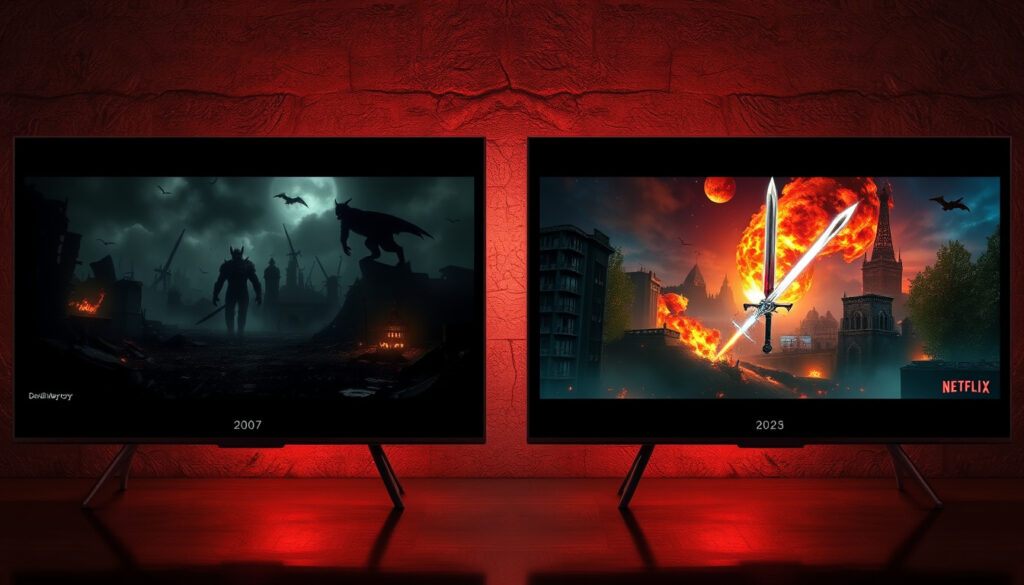
Devil May Cry Anime – 2025 Netflix vs 2007 Comparison
The Devil May Cry franchise has spawned two distinct anime adaptations spanning nearly two decades. While both feature the demon hunter Dante as their central figure, the 2025 Netflix series and the 2007 Madhouse production represent fundamentally different approaches to adapting Capcom’s action game franchise for animated storytelling.
The Netflix incarnation, produced by Adi Shankar and animated by Studio Mir, arrived on April 3, 2025, bringing high-octane action to a new generation of viewers. Meanwhile, the original 2007 series, produced by Madhouse, carved out its own legacy with a character-driven narrative set between the first and second games. These two productions offer contrasting experiences for fans and newcomers alike.
This comparison examines the key differences in storytelling approach, character portrayals, episode structure, and overall reception to help viewers understand what each adaptation brings to the franchise.
What is the Devil May Cry Anime on Netflix?
The Netflix Devil May Cry series represents a bold reimagining of the franchise for the streaming era. Produced by Adi Shankar and animated by Studio Mir, the series premiered its first season on April 3, 2025, delivering what Shankar describes as an “adult animated urban fantasy” experience packed with over-the-top flair and continuous action sequences.
Adi Shankar’s involvement connects this series to his broader “bootleg multiverse” concept, which places familiar characters from gaming and anime into new narrative configurations. Studio Mir, known for their work on animated series requiring fluid combat choreography, brings the demon-slaying action to life across what appears to be approximately 10 episodes in the first season.
The plot diverges significantly from game canon, placing Dante within Shankar’s multiverse framework as he battles interdimensional threats. The primary antagonist, White Rabbit, leads an army of demons against the series’ protagonist, creating stakes that feel fresh while retaining the franchise’s signature demon-hunting premise.
Key Details at a Glance
- 2025 Netflix Series: Produced by Adi Shankar, animated by Studio Mir, TV-MA rating
- 2007 Original Series: 12 episodes available, produced by Madhouse
- Protagonist: Dante, the iconic demon hunter from Capcom’s game franchise
- Platform Connection: Both based on the Devil May Cry game series by Capcom
Critical Insights
- The 2025 series received generally positive critical reviews, contributing to Devil May Cry 5 sales exceeding 10 million copies
- Voice casting pairs Johnny Yong Bosch (known for Nero in the games and Ichigo in Bleach) as Dante
- The soundtrack features licensed rock and metal tracks from artists like Limp Bizkit and Evanescence
- Lady takes on a prominent role in the Netflix adaptation, featuring more prominently than in the 2007 series
- The 2007 series maintains stronger fidelity to game mechanics and story progression
- Netflix renewed the series for a second season just one week after the initial premiere
| Version | Episodes | Platform | Release Year |
|---|---|---|---|
| Netflix 2025 | 10 | Netflix | 2025 |
| 2007 Series | 12 | Crunchyroll | 2007 |
What was the Devil May Cry Anime 2007?
The original Devil May Cry anime, produced by Madhouse, aired in 2007 as a 12-episode television series. This adaptation occupies a unique position in the franchise timeline, functioning as a semi-canon bridge story set between the events of Devil May Cry 1 and Devil May Cry 2.
Story Structure and Tone
Unlike the high-speed action of the Netflix version, the 2007 series adopts a more measured pace. The narrative follows Dante operating his financially strained Devil May Cry agency, handling predominantly self-contained episodic cases that gradually build toward an overarching plot derived from the franchise’s manga and novel expansions.
This approach mirrors the day-to-day agency life familiar to players of the source games, offering viewers extended character moments alongside demon-hunting action. The slower burn allows for deeper exploration of supporting characters while maintaining the gothic atmosphere that defines the franchise aesthetic.
Voice Cast and Performance
The 2007 series secured the original game voice talent, with Reuben Langdon returning to voice Dante. Langdon had established himself as the character’s voice across multiple game installments, lending authenticity to the portrayal. Additional voice cast members include Toshiyuki Morikawa and Atsuko Tanaka, contributing to a production that felt connected to the source material’s Japanese roots.
Critics and fans offered mixed responses to the 2007 adaptation. While demon designs, gore effects, and character development received praise, the series’ limited action sequences disappointed viewers expecting the over-the-top combat the games deliver. Off-screen enemy transformations and restrained fight choreography fell short of franchise expectations.
Who are the Main Devil May Cry Anime Characters?
Both adaptations center on demon hunter Dante, but the supporting casts and character portrayals diverge significantly between versions. Understanding these differences illuminates how each production interprets the franchise’s iconic figures.
Dante: Contrasting Interpretations
In the 2007 series, Dante maintains the cocky personality fans recognize from the games while displaying unexpected tenderness toward Patty, a young girl who becomes his temporary ward. This softer dimension, often absent from the game’s combat-focused scenarios, received appreciation from viewers seeking emotional depth alongside action.
The Netflix 2025 version reimagines Dante as a more action-hero oriented figure. Voiced by Johnny Yong Bosch rather than series veteran Reuben Langdon, this Dante operates within Shankar’s multiverse concept and participates in fight sequences described as over-the-top and non-stop. Some fans have criticized the characterization as “nerfed” compared to the games’ powerhouse portrayal.
Supporting Characters Across Versions
| Character | 2007 Series Role | 2025 Netflix Role |
|---|---|---|
| Lady | Introduced as franchise heroine | Key role, actively fights alongside Dante |
| Trish | Featured heroine with significant presence | Appears but receives less emphasis |
| Patty | Young girl sidekick revealing Dante’s softer side | Not featured |
| White Rabbit | Not present | Main antagonist leading demon forces |
Lady emerges as particularly prominent in the Netflix adaptation, taking on an active combat role that occasionally positions her as an equal to Dante. In contrast, the 2007 series introduces her as a franchise fixture while developing her relationship with Dante across multiple episodes.
The White Rabbit represents the Netflix series’ primary antagonist, an entirely new creation for the animated medium. This character leads interdimensional demon threats against Dante, serving as the central villain for the first season’s narrative arc.
How Many Episodes Are in Devil May Cry Anime?
The episode counts and formatting differ substantially between the two Devil May Cry anime productions. The 2007 series offers a concrete 12-episode structure, while the 2025 Netflix adaptation’s first season contains 10 episodes of continuous, fast-paced action.
Episode Structure Comparison
The 2007 series employs a “monster-of-the-week” episodic format with self-contained demon-hunting cases. Each episode typically introduces a standalone threat that Dante confronts before moving to the next assignment. These individual cases weave into a larger narrative arc based on expanded universe materials, creating satisfying resolution within individual episodes while building cumulative storyline momentum.
The Netflix 2025 series adopts a fully serialized approach. Rather than resetting after each episode, the narrative unfolds continuously across all 10 installments, with events and consequences carrying forward throughout the season. This structure prioritizes ongoing tension and cliffhanger moments over the episodic satisfaction of completed monster hunts.
Action Density Differences
Despite the 2007 series offering more episodes, viewers expecting sustained combat may find the experience underwhelming. Action sequences in the Madhouse production often occur off-screen, with transformations and battle climaxes happening between scenes rather than on full display.
The Netflix version delivers continuous action as a selling point. The series emphasizes non-stop demon combat, with fight choreography taking center stage across episode runtimes. This approach appeals to viewers seeking the explosive combat the games deliver, though some longtime fans argue the emphasis on spectacle compromises character development.
Is There a Devil May Cry Anime Season 2?
Netflix announced a second season renewal for the Devil May Cry anime just one week following the April 3, 2025 premiere of season one. The second season is scheduled to premiere on May 12, 2026, representing a relatively swift turnaround from announcement to expected release.
The rapid renewal reflects both the streaming platform’s confidence in the production and the series’ early audience reception. Critical reviews remained generally positive, and the series contributed to measurable growth in franchise game sales, demonstrating commercial viability for continued investment.
Specific plot details, returning cast members, and episode counts for season two had not been confirmed at the time of this comparison. Information regarding whether the second season continues Shankar’s multiverse narrative or potentially adapts more directly from game storylines remains limited to preliminary announcements.
2007 Series Continuation Status
The 2007 Madhouse production concluded its 12-episode run without any announced continuation. Despite maintaining a dedicated fanbase who appreciate its game-faithful approach and character depth, no second season, OVA continuation, or reboot has materialized in the nearly two decades since original broadcast.
The Devil May Cry Anime Timeline
Understanding the franchise’s evolution across media requires examining the relationship between game releases and anime productions. The following timeline places both anime adaptations within the broader Devil May Cry chronology.
- — Devil May Cry game released for PlayStation 2, establishing Dante as Capcom’s flagship action hero
- — Devil May Cry 2 expands the franchise with additional gameplay mechanics and story content
- — Devil May Cry: The Animated Series airs for 12 episodes, produced by Madhouse
- — Netflix Devil May Cry series premieres April 3, produced by Adi Shankar and animated by Studio Mir
- — Season 2 scheduled to premiere on May 12
The nearly 18-year gap between productions reflects changing approaches to game-to-anime adaptation in the streaming era. Where the 2007 series functioned as supplementary canon bridging game installments, the Netflix version operates as a more independent reimagining designed for potentially expansive serialized storytelling.
Confirmed Facts and Outstanding Questions
When examining available information about both Devil May Cry anime productions, certain details remain firmly established while others require further confirmation or remain entirely unaddressed in public sources.
| Established Information | Remaining Unclear |
|---|---|
| 2007 series ran for 12 episodes | Specific episode breakdown for Netflix season 1 beyond total count |
| Netflix series premiered April 3, 2025 | Full voice cast beyond primary characters |
| Season 2 confirmed for May 12, 2026 premiere | White Rabbit’s full backstory and motivation |
| Johnny Yong Bosch voices Dante in Netflix version | Whether season 2 maintains original voice cast |
| Reuben Langdon voiced Dante in 2007 series | Production budget or episode order comparisons |
Information regarding the White Rabbit character remains particularly limited. Available sources confirm the character’s role as primary antagonist leading demon forces, but deeper backstory, connection to the game mythology, or full character motivations have not been publicly detailed by the production team.
Context: Game Adaptation Differences
The two anime adaptations represent contrasting philosophies regarding source material fidelity. The 2007 series operates as semi-canon, filling narrative space between established game events while maintaining character behaviors and agency dynamics consistent with player experiences.
The Netflix production prioritizes spectacle and accessibility over strict game adherence. Shankar’s multiverse concept allows characters to interact across narrative boundaries, creating situations impossible within traditional game chronology. This approach attracts viewers seeking fresh takes while potentially alienating fans invested in established franchise lore.
Critical reception reflects this philosophical divide. Die-hard franchise enthusiasts frequently favor the 2007 adaptation for its authenticity to source material tones and mechanics. Casual viewers and those new to the property tend toward the Netflix version’s energetic action presentation, finding the continuous combat more immediately engaging than character-driven episodic storytelling.
What Sources Say
Public statements from production figures and media coverage provide insight into creative intentions behind both anime adaptations.
Adi Shankar described the Netflix series as an “adult animated urban fantasy” experience, emphasizing the production’s commitment to mature themes and visual flair appropriate to the streaming platform’s mature audience rating.
— Production interviews documented through industry coverage
Critical aggregators documented generally positive reviews for the Netflix adaptation, with particular emphasis on how the series’ entertainment value translated to measurable franchise growth. Devil May Cry 5 sales surpassing 10 million copies following the series premiere suggests effective cross-promotional value between streaming and gaming properties.
Fan reception for the 2007 series highlighted strong demon design and horror atmosphere, though the limited action sequences and episodic pacing drew consistent criticism from viewers expecting gameplay-level combat intensity.
— Community discussions and retrospective analyses
Summary
The Devil May Cry anime franchise spans two distinct productions separated by nearly two decades. The 2025 Netflix series, produced by Adi Shankar and animated by Studio Mir, prioritizes continuous action and multiverse storytelling, featuring Johnny Yong Bosch as Dante and introducing White Rabbit as a new antagonist. With season two confirmed for May 2026, this adaptation represents a significant streaming investment in the franchise.
The 2007 Madhouse production offers a more measured, character-driven experience across 12 episodes, maintaining stronger fidelity to game canon and featuring Reuben Langdon’s established Dante performance. While reception proved mixed regarding its restrained action, the series remains valued by fans seeking expanded universe content grounded in franchise fundamentals.
Both adaptations demonstrate how source material can be interpreted through different creative lenses, with neither approach universally superior. Viewer preference ultimately depends on whether one prioritizes game-authentic storytelling or fresh spectacle-driven reimagining. Those interested in exploring related anime adaptations might also examine Chainsaw Man – The Movie: Reze Arc or The Flash Movie Cast for additional genre context.
Frequently Asked Questions
What game is Devil May Cry based on?
Devil May Cry originates as a Capcom action game series first released in 2001 for PlayStation 2. The franchise has since expanded across multiple numbered installments, spin-offs, and now animated adaptations.
Is Devil May Cry anime Rabbit a character?
The White Rabbit serves as the primary antagonist in the 2025 Netflix series, leading interdimensional demon threats against Dante. Available sources confirm this role without providing extensive character backstory.
Where can I watch the Devil May Cry anime?
The 2025 Netflix series streams exclusively on Netflix. The 2007 series remains available through Crunchyroll’s anime catalog.
Who voices Dante in the 2025 Netflix series?
Johnny Yong Bosch voices Dante in the Netflix adaptation. Bosch is known for voicing Nero in Devil May Cry games and Ichigo Kurosaki in Bleach.
How does the 2025 series differ from the 2007 anime?
The Netflix version features continuous serialized action within a multiverse framework, while the 2007 series employs episodic storytelling set between game events. The Netflix production also features different voice casting and original plot elements not present in games.
When did the Devil May Cry anime 2025 release?
Season one of the Netflix Devil May Cry anime premiered on April 3, 2025, containing 10 episodes of original storyline content.
More related posts
 Report a Problem Apple: Login, Refunds & Guide
 Drea de Matteo Movies and TV Shows: Iconic Roles & OnlyFans
 Who Is Vanessa Trump? Age, Children, Net Worth, Tiger Woods
 Subaru Outback for Sale: Best Years, Problems & Tips
 Fred Meyer Near Me: Store Locator, Hours & Pharmacy
 Jumanji Welcome to the Jungle Cast – Complete Actor Guide
 Jock Itch: Causes, Symptoms, and Effective Treatment Guide