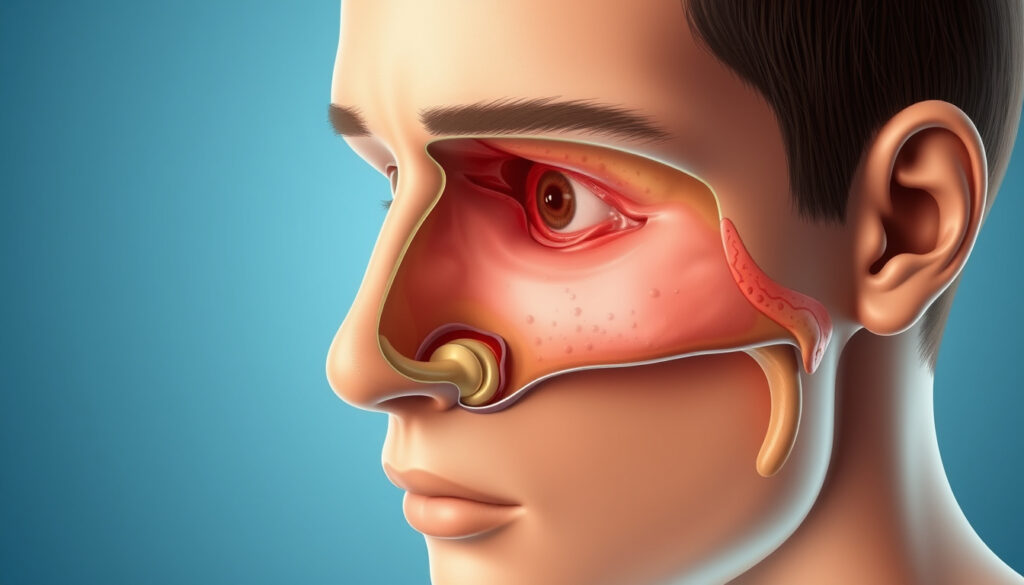
Is a Sinus Infection Contagious? What to Know
A stuffy nose, pressure behind your eyes, that foggy feeling — and suddenly you’re wondering if you should cancel your plans. It’s a fair question: is a sinus infection contagious? The short answer, according to Harvard Health Publishing (Harvard Medical School), is both yes and no. Here’s what separates a contagious cold from the sinus inflammation it leaves behind — and how to protect the people around you.
Sinus infections caused by viruses: Over 90% ·
Contagious period after symptom onset: 3–5 days ·
Typical duration of sinus infection: 7–10 days ·
Bacterial sinus infections: Less than 10% of cases
Quick snapshot
- Sinusitis itself not contagious (Cleveland Clinic (leading hospital))
- Viral triggers contagious for 3–5 days (Healthcare Associates of Texas (ENT clinic))
- Bacterial infections rarely spread (NHS (U.K. national health authority))
- Facial pain, nasal congestion, thick discharge (UCHealth (university health system))
- Fever possible but not required (CHRISTUS Health (regional hospital network))
- Cough and sneeze spread virus (CDC Safe Healthcare Blog (U.S. federal health agency))
- Rest and hydration (NHS (U.K. national health authority))
- Saline rinses and steam (Cleveland Clinic (leading hospital))
- Antibiotics only if bacterial (rare) (NHS (U.K. national health authority))
- Handwashing frequently (Cleveland Clinic (leading hospital))
- Avoid close contact when symptomatic (Healthcare Associates of Texas (ENT clinic))
- Cover coughs and sneezes (CDC Safe Healthcare Blog (U.S. federal health agency))
Five key facts, one pattern: most sinus infections share the same root cause — and that root cause dictates whether you can pass it on.
| Fact | Value |
|---|---|
| Cause | Mostly viral (90%+) |
| Contagious | Only if viral, not bacterial |
| Contagious period | 3–5 days from symptom onset |
| Treatment | Supportive care; antibiotics rare |
| Prevention | Hand hygiene, avoid sick contacts |
Can you catch a sinus infection from someone?
The confusion starts with the word “sinus infection.” What you’re really asking: can the runny nose, facial pain, and congestion I’m seeing spread to someone else? The answer depends entirely on what’s causing it.
Is sinusitis itself contagious?
Sinusitis — the inflammation of the tissue lining your sinuses — is not contagious, as Cleveland Clinic (leading hospital) makes clear. Inflammation is your body’s immune response, not an invader you can catch. What travels from person to person are the viruses or bacteria that trigger that inflammation in the first place.
What causes sinus infections to be contagious?
Over 90% of sinus infections are viral, according to NHS (U.K. national health authority). Common cold viruses — rhinoviruses, coronaviruses, influenza — cause the initial infection, which then inflames your sinuses. When you cough, sneeze, or touch shared surfaces, that virus can spread. Bacterial sinus infections, by contrast, are far less common and rarely contagious, NHS (U.K. national health authority) notes.
You can’t give someone your sinus inflammation alone — but the virus that started it is highly contagious. That’s why Harvard Health Publishing (Harvard Medical School) calls the answer “both yes and no.”
What this means: if you walk into an office with a viral sinus infection, colleagues aren’t at risk of your facial pain — but they can catch the cold that caused it, which may turn into their own sinus infection.
How long are sinus infections contagious?
This is the question that keeps people guessing about work, social plans, and family gatherings. The contagious window depends on the timeline of the underlying viral infection.
How long after starting antibiotics is sinus infection contagious?
Antibiotics don’t affect viruses. If you have a viral sinus infection — which NHS (U.K. national health authority) says is the vast majority — antibiotics won’t shorten your contagious window. You remain contagious for the typical 3–5 days after symptom onset, regardless of medication. Healthcare Associates of Texas (ENT clinic) and CHRISTUS Health (regional hospital network) both emphasize that symptom severity, not antibiotic use, drives risk.
Is a sinus infection contagious after 2 weeks?
By 7–10 days, most viral sinus infections have run their course, as UCHealth (university health system) explains. If symptoms persist past 10 days without improvement, the CDC (U.S. federal health agency) flags this as a possible sign of bacterial sinusitis — which is rarely contagious. After two weeks, you’re effectively no longer contagious, though symptoms may linger from inflammation, not active viral shedding.
Can you be contagious without a fever?
Absolutely. Fever is not required for contagiousness. Many people spread viral infections before they know they’re sick, as Healthcare Associates of Texas (ENT clinic) points out. Sneezing, coughing, and runny nose — with or without a temperature — are enough to pass the virus to others.
Should you stay away from people if you have a sinus infection?
The CDC and major hospital systems agree on the principle: take precautions during the contagious window. But “stay away” looks different for a mild cold vs. a full-blown sinus infection with fever.
Should I go to work with a sinus infection?
If symptoms are mild — some congestion, no fever — CHRISTUS Health (regional hospital network) suggests you can likely work remotely or take basic hygiene precautions: frequent handwashing, covering sneezes, and keeping distance. If you have a fever, severe facial pain, or a productive cough, stay home until fever resolves and symptoms improve, consistent with CDC (U.S. federal health agency) guidance for respiratory illnesses.
- Stay home if you have a fever or feel systemically unwell
- Return when fever is gone for 24 hours without fever-reducing meds
- Keep distance from others during the first 3–5 symptomatic days
Should I isolate from family?
Household transmission is common with viral infections. Cleveland Clinic (leading hospital) advises good hygiene because the viruses that cause sinusitis spread easily in close quarters. You don’t need a separate room, but avoid sharing utensils, towels, or close face-to-face contact during peak contagious days.
A parent with a viral sinus infection passes it to a child, who gets a cold, misses school, and may develop their own sinus infection. The chain of transmission starts with the virus — not the sinus inflammation — and the precautions you take during those first few days break that chain.
How do I get rid of a sinus infection asap?
There’s no magic shortcut, but smart supportive care can reduce symptom severity and help your immune system clear the virus faster. The key: don’t reach for antibiotics unless a doctor confirms a bacterial cause.
What clears up a sinus infection quickly?
NHS (U.K. national health authority) recommends rest, hydration, and over-the-counter pain relievers as first-line treatments. Specifically:
- Drink plenty of fluids to thin mucus
- Use saline nasal spray or a neti pot to flush sinuses (Cleveland Clinic (leading hospital) notes this as a common recommendation)
- Apply warm compresses to your face for pressure relief
- Take acetaminophen or ibuprofen for pain and fever
- Use steam inhalation — a bowl of hot water or a hot shower
What not to do during a sinus infection?
Overusing decongestant sprays is a common mistake, as NHS (U.K. national health authority) warns: using them for more than three days can cause rebound congestion. Another error: demanding antibiotics for what is likely a viral infection. CDC (U.S. federal health agency) emphasizes that overuse of antibiotics for sinusitis drives resistance without offering benefit.
What kills a sinus infection naturally?
“Natural” remedies won’t kill a virus directly, but they support your immune system and make symptoms more tolerable. Some have evidence behind them; others are comfort measures with limited data.
What drink will clear my sinuses?
Warm fluids like herbal tea, hot water with honey and lemon, or clear broth help thin mucus and keep you hydrated, NHS (U.K. national health authority) notes. While no single drink is a cure, staying hydrated is essential for recovery. Some research points to anti-inflammatory effects of turmeric and ginger in teas, but these are complementary, not curative (UCHealth (university health system) review of supportive care).
Are there effective home remedies?
- Neti pot / saline irrigation: Multiple hospital systems, including Cleveland Clinic (leading hospital), recommend this to flush mucus and allergens from sinuses
- Honey and lemon: Soothes sore throat associated with post-nasal drip, per NHS (U.K. national health authority)
- Steam inhalation: Moisture helps loosen thick mucus
- Humidifier: Adding moisture to dry air reduces nasal irritation
“If your infection starts with a virus, you may be contagious for a few days, especially during the early stages when symptoms such as sneezing and coughing are present.”
— CHRISTUS Health (regional hospital network)
The implication: home remedies are supportive, not curative. If you’re not improving after 7–10 days, or if you develop high fever and severe facial pain, seek medical evaluation for possible bacterial sinusitis.
Sinus infection timeline: when are you contagious?
Day 1–3
Peak contagiousness; symptoms most severe. Viral shedding is highest, and sneezing/coughing maximize spread (Healthcare Associates of Texas (ENT clinic)).
Day 4–7
Still potentially contagious, especially if coughing/sneezing continues. Many people improve by day 7 (UCHealth (university health system)).
After 7 days
Usually non-contagious; symptoms may persist from inflammation. If symptoms haven’t improved by day 10, see a doctor (CDC (U.S. federal health agency) guidance).
If bacterial
Contagiousness is very low. Treat with antibiotics only if confirmed by a healthcare provider (CDC Safe Healthcare Blog (U.S. federal health agency)).
What’s confirmed and what’s unclear
Confirmed facts
- Sinusitis itself is not contagious (Cleveland Clinic (leading hospital))
- Viral causes (e.g., cold viruses) are contagious (NHS (U.K. national health authority))
- Good hand hygiene reduces spread (Cleveland Clinic (leading hospital))
- Most sinus infections resolve in 7–10 days (UCHealth (university health system))
- Bacterial sinusitis is rare (<10% of cases) (NHS (U.K. national health authority))
What’s unclear
- Exact duration of contagiousness varies per individual (Healthcare Associates of Texas (ENT clinic))
- Whether bacterial sinusitis can be transmitted is debated among experts
- Role of asymptomatic viral shedding in sinus infection spread
sleepandsinuscenters.com, sleepandsinuscenters.com, dmvallergy.com, carolinaearnosethroat.com
For a deeper look at the science behind sinus infection contagiousness, health experts clarify the difference between viral and bacterial causes.
Frequently asked questions
Can a sinus infection turn into pneumonia?
Yes, but it’s uncommon. If a viral sinus infection extends to the lower respiratory tract, it can lead to bronchitis or pneumonia, especially in people with weakened immune systems (CDC (U.S. federal health agency)).
Is a sinus infection contagious to babies?
The underlying virus can be passed to babies, who are more vulnerable to respiratory infections. If you have a viral sinus infection, avoid close face-to-face contact with infants and practice hand hygiene (Cleveland Clinic (leading hospital)).
Do I need antibiotics for a sinus infection?
Typically not. Only about 2-10% of sinus infections are bacterial, according to NHS (U.K. national health authority). Antibiotics are prescribed only when symptoms last more than 10 days, worsen after improvement, or are severe with high fever.
What is the difference between a cold and sinus infection?
A cold primarily affects the nasal passages with clear discharge and sneezing, while a sinus infection involves inflammation of sinus cavities — causing facial pain, pressure, and thick discolored mucus. UCHealth (university health system) notes that colds typically peak at 2-3 days and resolve within a week, whereas sinusitis can last 7-10 days or longer.
Can you get a sinus infection from a virus?
Yes — in fact, most sinus infections begin as a viral upper respiratory infection. The virus causes inflammation of the sinus lining, leading to the classic symptoms of sinusitis (NHS (U.K. national health authority)).
How can I prevent recurring sinus infections?
Address triggers like allergies, avoid smoking, hydrate, use a humidifier in dry environments, and practice good hand hygiene (Cleveland Clinic (leading hospital)).
Is it safe to exercise with a sinus infection?
Light activity is generally fine if symptoms are mild and above the neck (congestion only). However, if you have fever, body aches, or chest congestion, rest is recommended (CHRISTUS Health (regional hospital network)).
When should I see a doctor for a sinus infection?
See a doctor if symptoms last more than 10 days without improvement, you have a high fever (>102°F), severe facial pain, or symptoms worsen after initially improving (CDC (U.S. federal health agency)).
For most people dealing with a sinus infection, the question of contagiousness boils down to one insight: you’re not giving someone your sinus pressure — you’re giving them a cold virus that might lead to their own sinus infection. The practical choice for someone deciding whether to go to work or spend time with family is clear: stay home during the first 3–5 symptomatic days if you have a fever or severe symptoms, and use hand hygiene religiously. For those with mild congestion only, precautions like masking and distancing reduce risk without requiring full isolation. The alternative — showing up and spreading the virus — could set off a chain of infections in your workplace or home that lasts longer than your own recovery.
Related reading
- Chautauqua Lake Algae: Health Risks & Safety Guide — Understand respiratory risks from environmental toxins
- What to Drink for Heartburn Relief: Fast Home Remedies — Supportive care for common health complaints
More related posts
 Japanese Yen to USD: Rate, Conversion & Why JPY Is Weak
 3i/ATLAS Update Today: NASA Tracking & Latest News
 Pokémon Games in Order: Release, Play & Generation Guide
 The Flash Movie Cast – Complete Actors and Roles Guide
 Outdoor Table and Chairs: Complete Ireland Buying Guide
 How Much Water Is Too Much? Daily Limits and Risks
 What Is a Coefficient? Definition & Examples in Math, Science
 24 Hour Stores Near Me: Where to Shop Late in Ireland and US