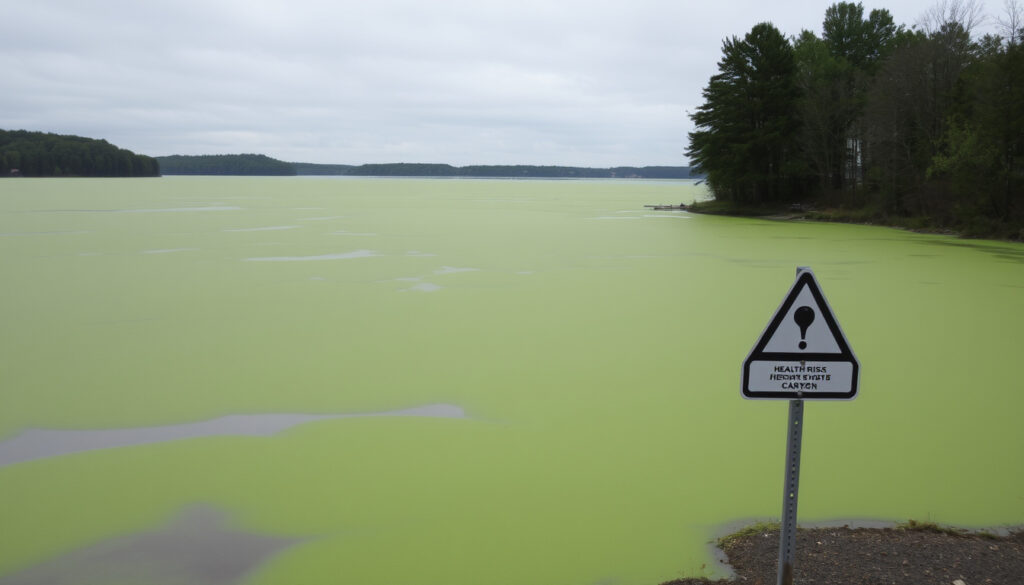
Chautauqua Lake Algae: Health Risks & Safety Guide
If you live on or visit Chautauqua Lake, you’ve likely watched the water turn green and wondered: is it safe to swim, fish, or just be near the shore? Harmful algal blooms (HABs) have become a recurring summer reality here, driven by decades of nutrient runoff and a web of competing interests among lake organizations. This guide distills the latest data, official advisories, and local voices to help homeowners and visitors make informed decisions about health, property, and recreation.
Lake surface area: 13,000 acres ·
Maximum depth: 78 feet ·
NYSDEC HAB reports (2025 season to date): Multiple advisories ·
Primary cause: Nutrient runoff (phosphorus and nitrogen) ·
Lead monitoring agency: New York State Department of Environmental Conservation (NYSDEC)
Quick snapshot
- HABs produce toxins harmful to humans and pets (NYSDEC – Watershed Program)
- Nutrient pollution is the primary driver of HABs (NYSDEC – Watershed Program)
- NYSDEC issues official advisories when HABs are confirmed (Chautauqua County – Recreational Water Safety)
- Short-term effectiveness of certain chemical treatments on long-term lake health
- Exact timeline for implementing large-scale watershed planning measures
- Quantified property value decline attributable solely to algae vs. other factors
- HAB frequency and duration have increased since 2018 (NYSDEC – Watershed Program)
- 2022 spike in homeowner complaints and media coverage (Chautauqua Lake Association – HAB Report)
- 2024 research identified missteps in past algae management (NYSDEC – Watershed Program)
- Community meetings on watershed strategies in 2025
- Ongoing NYSDEC HAB monitoring and advisory updates (NYSDEC – Watershed Program)
- Lake association call for expanded sampling funding
Six key facts about the lake at a glance, drawn from official sources.
| Attribute | Value |
|---|---|
| Lake size | 13,000 acres |
| Maximum depth | 78 feet |
| Waterbody type | Natural (not man-made) |
| Primary recreation | Fishing, boating, swimming |
| HAB monitoring agency | NYSDEC |
| Recent HAB trend | Increased frequency and duration since 2018 |
Is Chautauqua Lake a Clean Lake?
The short answer is no — at least not by the standards of safe swimming and thriving aquatic life. The New York State Department of Environmental Conservation (NYSDEC, the state’s environmental regulator) reports that excess nutrients — especially phosphorus and nitrogen — and sediment from the watershed degrade Chautauqua Lake’s water quality. These nutrients come from sewage, manure, inorganic fertilizer, urban stormwater, and sediment-bound phosphorus from eroded streambanks, fields, and rural roads. As a result, the lake experiences seasonal harmful algal blooms (HABs) that have grown more frequent and longer in duration since 2018.
Water quality monitoring results
- The Chautauqua Lake Association (local lake management nonprofit) conducts limited monitoring for financial reasons, checking only a subset of sites each week.
- NYSDEC tracks water quality parameters across the lake and publishes an interactive HAB map.
- Chautauqua County (official health department) monitors permitted bathing beaches for E. coli and HABs, closing beaches when thresholds are exceeded.
Nutrient pollution and HAB triggers
- Phosphorus is the limiting nutrient; when it runs off fields and lawns into the lake, cyanobacteria (blue-green algae) explode in population.
- Invasive plants like Eurasian Water Milfoil also contribute by reducing water circulation and increasing nutrient cycling, as noted by the Chautauqua Lake Partnership (advocacy group).
- NYSDEC developed a Harmful Algal Bloom Action Plan for Chautauqua Lake in 2018 together with the state health and agriculture departments.
Agricultural and residential run-off feed the algae, but reducing fertilizer use and restoring shoreline buffers face political and economic pushback from property owners who want manicured lawns and high crop yields.
The implication: without addressing the political economy of nutrient reduction, the lake will remain in a degraded state.
Can You Swim in Chautauqua Lake, NY?
Yes — but only when there is no active HAB advisory at your chosen beach. The Chautauqua County health department states that beaches are closed if water quality concerns — including HABs or elevated E. coli — are identified, and remain closed until the cause is gone. Beaches may also close for non-water-quality reasons such as staffing or weather.
Current swimming advisories
- As of mid-2025, several beaches are listed as closed: Mayville Lakeside Park, Children’s Beach at Chautauqua Institution, College/Pier Beach at Chautauqua Institution, and Lakewood Village Beach.
- The Chautauqua Lake Association (CLA) reported that most areas of the lake remained swimmable during its sampling week, but one South Basin site — Oriental Park near the Chautauqua Lake Bridge — met criteria for recommended avoidance of contact.
- CLA found 3 South Basin locations and 1 North Basin location with bluegreen algal bloom presence.
Risks of cyanobacteria exposure
- Contact with cyanobacteria can cause skin irritation, nausea, vomiting, diarrhea, and respiratory issues (Chautauqua County health guidance).
- Pets that ingest water with high toxin levels can die quickly.
- The CLA warns that even if a beach is open, swimmers should avoid visible scum or discolored water.
The pattern: swimming is a conditional privilege on Chautauqua Lake, dependent on real-time monitoring and swift public communication.
What Does a Toxic Algae Bloom Do to Humans?
Cyanobacteria, the organisms behind HABs, can produce multiple toxins that affect the liver, nervous system, and skin. The acute effects are well-documented by state and county health authorities.
Acute health symptoms
- Nausea, vomiting, diarrhea, skin rashes, and eye irritation are the most common symptoms after direct contact or ingestion (Chautauqua County – Recreational Water Safety).
- High bacteria levels in beach water also pose a risk if water is swallowed or if swimmers have open wounds.
- Seek medical attention if symptoms develop after exposure.
Pets and livestock risks
- Dogs are especially vulnerable because they drink while swimming and may not show symptoms until it is too late.
- NYSDEC recommends keeping pets out of any water that looks green, has surface scum, or has an unusual odor.
- Chronic exposure in humans may be linked to liver and nerve damage, though data on long-term effects at the levels seen in Chautauqua Lake remain limited.
For families with young children and dog owners, a brief visit to the lake can turn into an emergency room trip. The risk is not theoretical — the CLA’s monitoring confirmed HABs at multiple sites in 2025.
The catch: routine lake recreation can become a medical event without warning, making pre-trip checks essential.
Chautauqua Lake Homeowners’ Algae Concerns Today
Residents are increasingly vocal about the impact of HABs on property values, recreation, and quality of life. A July 2025 news report captured the frustration: one longtime homeowner told WIVB that political disagreements among lake organizations were “the most toxic” issue of all, worse than the algae itself.
2025 community voices and media coverage
- Homeowners report that weed and algae growth makes swimming, boating, and fishing less enjoyable and sometimes impossible.
- Disputes between the Chautauqua Lake Association, Chautauqua Lake Partnership, and local government complicate coordinated management.
- NYSDEC is working on a watershed program to address nutrient sources, but progress is slow.
Political disagreements among lake organizations
- The CLA supports mechanical harvesting and targeted herbicide use, while the CLP favors more aggressive chemical treatments.
- Research from 2024 suggested that past control efforts — especially heavy herbicide applications — may have made matters worse by killing beneficial plants and releasing nutrients.
- Residents feel caught between competing agendas, with no clear authority to break the deadlock.
What this means: the governance gap is as urgent as the nutrient problem—neither can be solved in isolation.
Where Is the Current Chautauqua Lake Algae Bloom Map?
Knowing where blooms are active is the first step to staying safe. NYSDEC (New York’s environmental agency) publishes an interactive HAB notification map for all state waterbodies, including Chautauqua Lake.
NYSDEC HAB notification map
- The map shows confirmed bloom locations, dates of reports, and severity levels.
- Residents can subscribe to email alerts from DEC for their waterbody of interest.
- The map is updated regularly during the HAB season (typically June through October).
Real-time monitoring resources
- Chautauqua Lake Association releases weekly HAB reports during summer (Algal Bloom Special Report).
- Chautauqua County health department lists current beach closures on its Recreational Water Safety page.
- Local news outlets (e.g., WIVB, The Post-Journal) provide timely updates on bloom events.
The NYSDEC map relies on reports from the public and partner agencies; not every bloom is flagged immediately. If you see suspicious water, report it directly to DEC — it becomes a data point for everyone.
The takeaway: good data exists, but its impact depends on timely reporting and widespread public awareness.
Timeline of Key Events on Chautauqua Lake
- : NYSDEC reports significant HAB expansion on Chautauqua Lake (NYSDEC – Watershed Program).
- : Homeowner complaints spike; local media coverage intensifies (Chautauqua Lake Association – HAB Report).
- : Research study identifies missteps in past algae management.
- : Ongoing HAB advisories; community meetings on watershed strategies (multiple county and DEC notices).
Each year the blooms start earlier and last longer. Without a basin-wide nutrient reduction plan, this trend is expected to continue.
What We Know — and What’s Still Unclear
Confirmed facts
- HABs produce toxins harmful to humans and pets (NYSDEC – Watershed Program)
- Nutrient pollution (phosphorus, nitrogen) is the primary driver of HABs (NYSDEC – Watershed Program)
- NYSDEC issues official advisories when HABs are confirmed (Chautauqua County – Recreational Water Safety)
- Beaches closed due to HABs or bacteria as of 2025 season (four beaches listed closed).
What’s unclear
- Effectiveness of chemical treatments on long-term lake health
- Exact timeline for implementing large-scale watershed planning
- Quantified property value decline solely from algae vs. other factors
- Whether political disputes among lake organizations will be resolved soon
Voices from the Lake
“The most toxic issue on this lake is not the algae — it’s the politics. We have organizations fighting over methods while the water keeps getting worse.”
— Chautauqua Lake homeowner, speaking to WIVB (July 2025)
“Most of the lake is safe to swim in, but we need to be vigilant. Our monitoring program is limited by funding, so we rely on the public to report suspicious blooms.”
— Chautauqua Lake Association representative, Algal Bloom Special Report
“The department is committed to reducing nutrient inputs through the watershed program, but it requires long-term investment and cooperation from all stakeholders.”
— NYSDEC spokesperson, Watershed Program page
Related reading: Chautauqua County, NY – Recreational Water Safety · Algal Bloom Special Report – Chautauqua Lake Association
Frequently asked questions
What is a harmful algal bloom (HAB) in Chautauqua Lake?
A harmful algal bloom is a rapid overgrowth of cyanobacteria that can produce toxins affecting the liver, nervous system, and skin. In Chautauqua Lake, they are driven by excess phosphorus and nitrogen from runoff.
How can I tell if an algae bloom is toxic?
You cannot tell by eye; only laboratory testing can confirm toxins. As a precaution, avoid water that looks like green paint, pea soup, or has surface scum. The NYSDEC HAB map indicates confirmed blooms.
What should I do if I see a suspicious bloom on Chautauqua Lake?
Report it to the NYSDEC via their HAB reporting page. Also notify the Chautauqua Lake Association so they can update their monitoring.
Are HABs on Chautauqua Lake getting worse over time?
Yes. NYSDEC reports increased frequency and duration since 2018. Local monitoring in 2025 found active blooms at multiple sites.
Can I eat fish caught from Chautauqua Lake during a bloom?
NYSDEC advises that fish from waters with active blooms may accumulate toxins. Limit consumption of fish from affected areas, avoid eating the organs, and follow state fish advisories.
How do homeowners reduce nutrient runoff near the lake?
Use zero-phosphorus fertilizer, maintain shoreline buffers of native plants, direct downspouts away from the lake, and pick up pet waste. Every pound of phosphorus kept out of the lake reduces bloom potential.
Who is responsible for managing Chautauqua Lake water quality?
Multiple entities: NYSDEC (state regulation), Chautauqua County Health Department (beach monitoring), Chautauqua Lake Association (mechanical harvesting, education), Chautauqua Lake Partnership (advocacy), and local town boards (land-use permits). No single body has full authority, which often delays action.
For Chautauqua Lake homeowners, the choice is clear: either the fragmented governance structure unites behind a science-based watershed plan that tackles nutrient pollution at its source, or the lake’s health — and property values — will continue to decline. Waiting for a single bloom season to pass is not a strategy; the future of the lake depends on sustained, coordinated action starting now.
More related posts
 Cyberpunk 2077 Update 2.3: Release Date and New Features
 Subaru Outback for Sale: Best Years, Problems & Tips
 What Is Prompt Engineering – Techniques and Examples Guide
 Canelo vs Crawford Date, Time, Result & How to Watch
 Love Is Blind New Episodes: Season 10 Release Schedule
 Report a Problem Apple: Login, Refunds & Guide
 No Child Left Behind Act: History, Provisions and Replacement
 How to Reduce Inflammation in the Body: Fast, Effective Tips