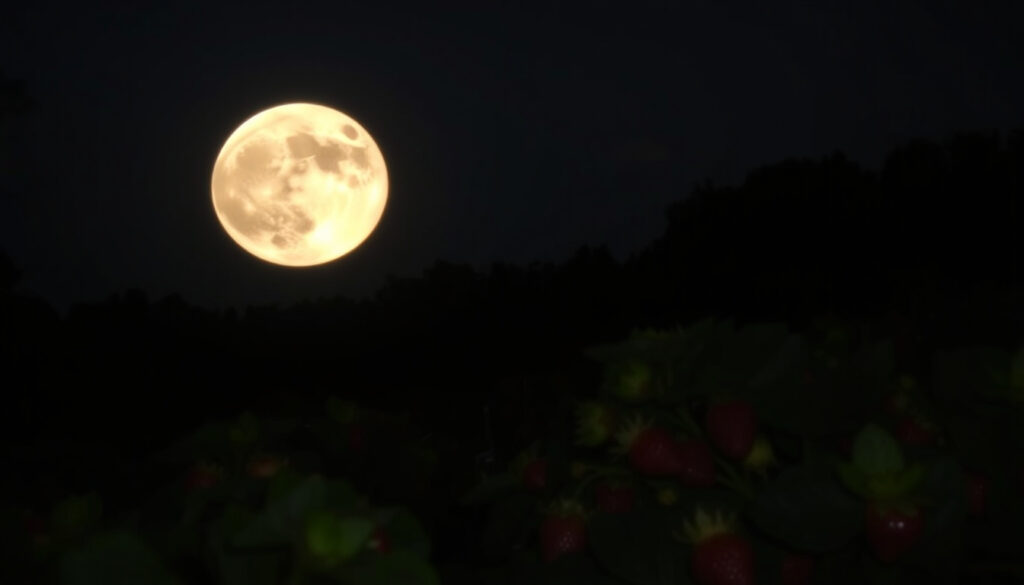
Full Moon June 2025: Date, Strawberry Moon Meaning & Effects
There’s something about a full moon that makes people look up — and the June 2025 Strawberry Moon is shaping up to be one of the most talked-about lunar events of the year. It’s not just a bright disk in the sky; this one comes with a rare low-hanging path that has astronomers buzzing.
Date: June 11, 2025 ·
Name: Strawberry Moon ·
Visibility: All night (June 10–11) ·
Peak: Early hours of June 11 ·
Season (Northern Hemisphere): Late spring
Quick snapshot
- Peak on June 11, 2025 (timeanddate (moon phase calendar))
- Visible all night from sunset June 10 to sunrise June 11 (timeanddate (astronomy tools))
- Peak at approximately 3:44–3:45 a.m. EDT (timeanddate (Strawberry Moon guide))
- Called the Strawberry Moon (The Old Farmer’s Almanac (traditional name authority))
- Named by Algonquin tribes for strawberry harvest season (The Old Farmer’s Almanac (folklore authority))
- Also known as Rose Moon, Honey Moon, or Mead Moon (timeanddate (full moon names reference))
- Lowest full moon visible in Northern Hemisphere in nearly 20 years (BBC Sky at Night Magazine (astronomy publication))
- Linked to a major lunar standstill (lunistice) that occurs every 18.6 years (timeanddate (lunar standstill overview))
- Great photographic opportunity — moon may appear golden or reddish near horizon (timeanddate (moon illusion explanation))
- No strong scientific evidence that full moons affect behavior (NASA Science (moon phase education))
- Some studies report minor sleep changes, but results are mixed (NASA Science (moon phase education) – same source, different aspect)
- Largely folklore — no need to change your plans (Farmers’ Almanac (astrology perspective))
The pattern: these four cards cover date, name, astronomical uniqueness, and behavioral folklore — a complete overview.
Six key facts, one pattern: the June 2025 full moon combines a precise astronomical date with deep cultural roots.
| Label | Value |
|---|---|
| Exact Date | June 11, 2025 |
| Moon Phase | Full |
| Traditional Name | Strawberry Moon |
| Name Origin | Algonquin tribes (The Old Farmer’s Almanac) |
| Visibility | All night (rises at sunset, sets at sunrise) |
| Season (Northern Hemisphere) | Late spring |
What day is the full moon in June of 2025?
The full moon in June 2025 reaches its peak on Wednesday, June 11, at approximately 3:44 a.m. EDT. The moon appears full for a night or two around that moment. It rises around sunset on June 10 and sets around sunrise on June 11, offering excellent all-night viewing.
What time will the full moon peak?
- Eastern Daylight Time (EDT): 3:44–3:45 a.m.
- Coordinated Universal Time (UTC): approximately 7:44 UTC
- Other time zones shift the date — for example, in UTC+12 the peak falls on June 11 evening
The exact second of fullness is the same everywhere — it’s just the clock on the wall that changes. The moon appears full for about a day surrounding the precise moment, so any time on the night of June 10–11 is good for viewing.
What this means: set your alarm for early June 11 if you want to catch the exact peak, but a casual glance on the evening of June 10 will still reward you.
Is the date the same worldwide?
No — the calendar date of the full moon depends on your time zone. In the Americas, the peak falls on June 11. In much of Europe, Africa, and Asia, the full moon also occurs on June 11 (UTC early hours). But in some Pacific time zones (like UTC+12), the peak may slip into June 12. Always check your local moonrise and set times via a reliable source.
What does a strawberry moon mean?
The name “Strawberry Moon” has nothing to do with the moon’s color — it’s a seasonal marker. Algonquin tribes used this name to signal the short window for harvesting wild strawberries in late spring. European settlers adopted it, and it remains the most popular name for June’s full moon.
Why is it called a strawberry moon?
- It originates from Algonquin-speaking peoples of the northeastern United States and eastern Canada.
- The name marks the season when strawberries ripen — typically a brief, intense harvest.
- Other traditional names include Rose Moon (Europe), Honey Moon, and Mead Moon, all reflecting late-spring flora or honey collection.
The moon itself looks the same color as any other full moon; any pink or orange tint is caused by low-altitude atmospheric scattering, not the name.
The catch: many people expect a pink moon, but the Strawberry Moon is usually pale yellow or white. The dramatic colors come only when it hugs the horizon.
How rare is the strawberry moon?
Every year has a June full moon, so the Strawberry Moon itself is not rare. But the June 2025 full moon stands out because it will be the lowest-hanging full moon visible from the Northern Hemisphere in nearly 20 years, as reported by BBC Sky at Night Magazine. This low arc is tied to a major lunar standstill — a periodic shift in the moon’s orbit that happens every 18.6 years.
Why is the June 2025 strawberry moon considered rare?
- The moon travels an unusually low path across the sky because it sits opposite the sun near the June solstice.
- A major lunar standstill (lunistice) amplifies this effect, making the moon rise and set at extreme northerly and southerly points on the horizon.
- The last comparable low full moon was in 2006, and the next won’t occur until around 2043.
For photographers, this is a golden opportunity. A low moon often appears larger and can take on golden, orange, or reddish hues due to the atmosphere’s prism effect. Our brains perceive the moon as bigger near the horizon, even though its angular size is constant.
Why it matters: if you’ve never seen a full moon skimming the treeline, June 2025 is your best shot until 2043.
Does a full moon affect behavior?
Lore says full moons cause erratic behavior, emergency room visits, and restless sleep. Science says not so much. Despite widespread belief, controlled studies find little to no consistent link between the lunar phase and human actions.
What does science say about full moon effects?
- Studies on crime, psychiatric admissions, and emergency calls show no meaningful correlation.
- Some research suggests a minor effect on sleep: one 2021 study found that people took slightly longer to fall asleep and had less deep sleep during a full moon — but the effect was small and inconsistent.
- The moon’s gravity affects tides, not human brains, and any behavioral influence is plausibly due to increased nighttime light exposure before artificial lighting.
The trade-off: if you feel wired on full moon nights, the extra brightness might be the culprit, not a mystical force. Close your curtains and you’ll probably sleep fine.
Does the full moon affect sleep?
Possibly a little. A 2013 study in Current Biology found that participants slept 20 minutes less on average during full moons, but later larger studies failed to replicate the result. The moon illusion and light pollution may also play a role. Still, the effect is too small to worry about for most people.
While some studies suggest minor sleep changes, the effect is too small to worry about for most people.
What to avoid during a full moon?
Common advice on social media suggests avoiding major decisions, risky driving, or starting new ventures during a full moon. But there’s no scientific basis for these warnings. According to Farmers’ Almanac, some astrologers caution against impulsive choices, but that’s spiritual guidance, not evidence.
What should you not do on a full moon?
- Make hasty decisions: no data shows full moons impair judgment, but it’s always wise to pause.
- Drive without caution: if you’re distracted by the bright moon, pull over — but crashes don’t spike on full moon nights in controlled studies.
- Ignore sleep hygiene: the extra light might interfere with melatonin, so keep your bedroom dark.
The bottom line: enjoy the spectacle, but you don’t need to change your routine. If you’re worried, treat it like any bright night.
For photographers and skywatchers, the low altitude of the June 2025 Strawberry Moon creates a rare chance to capture the moon with foreground objects. BBC Sky at Night Magazine calls it “the best opportunity in nearly two decades” for dramatic wide-angle photos.
Timeline
Key dates related to the June 2025 full moon and its unusual behavior.
- June 10, 2025 (evening): Strawberry Moon rises at sunset across most of the Northern Hemisphere (timeanddate (astronomy tools)).
- June 11, 2025 (early hours): Full moon peaks at ~3:44 a.m. EDT (timeanddate (moon phase calendar)).
- June 2025 – major lunar standstill: The moon’s rising and setting points are at their most extreme — a phenomenon that recurs every 18.6 years (NASA Science (lunar standstill overview)).
- ~2043: Next comparable low full moon after 2025, according to BBC Sky at Night Magazine (BBC Sky at Night Magazine (future standstill prediction)).
What’s confirmed and what’s still unclear
Confirmed facts
- June 11, 2025 is the date of the full moon (peak time verified by timeanddate).
- The moon is traditionally called the Strawberry Moon (The Old Farmer’s Almanac).
- The name comes from Algonquin tribal harvest seasons (The Old Farmer’s Almanac).
- The 2025 full moon is unusually low in the sky due to a major lunar standstill (BBC Sky at Night Magazine).
- Scientific studies do not support significant behavioral or sleep effects from full moons (timeanddate).
What’s unclear
- Whether the June 2025 full moon is “rare” in a scientific sense (it’s not astronomically rare, but the low altitude and standstill make it a notable event).
- Whether the moon’s low path will be visible from all Northern Hemisphere latitudes equally — local terrain and weather matter more than latitude.
- Whether the moon illusion makes a real difference in perceived size — the effect is psychological, not physical.
- Whether the exact 20-year gap is precisely 19 years or 20 — different sources may round.
- Whether the next comparable low full moon will land exactly in 2043 — the standstill cycle is 18.6 years, but exact lunar geometry may vary.
The division between confirmed and unclear helps readers separate established facts from ongoing questions.
“June’s full moon always brings a special light to the landscape — but in 2025, the moon will hug the horizon in a way we haven’t seen in almost 20 years. It’s a fantastic target for anyone with a camera.”
— BBC Sky at Night Magazine, report on the Strawberry Moon 2025
“The Strawberry Moon name reminds us that the moon has always been a calendar for people on the ground — it tells you when to plant, when to harvest, when to celebrate.”
— The Old Farmer’s Almanac, full moon names archive
The June 2025 Strawberry Moon arrives at a time when the moon’s orbit is at its most extreme, creating a low-hanging spectacle that photographers and casual observers alike will remember. For anyone living in the Northern Hemisphere, the clear takeaway is simple: mark the night of June 10–11, find a spot with a clear horizon, and look southwest after sunset. You won’t see another full moon this low until 2043.
Related reading: Winter Solstice 2025
Frequently asked questions
Is the strawberry moon actually pink?
No. The name comes from strawberry harvest timing, not color. The moon may appear orange or red when it’s low on the horizon due to atmospheric scattering, but that can happen with any full moon.
Does the full moon cause more crime?
Research has not found a consistent link between full moons and crime rates. A 2019 meta-analysis of over 20 studies showed no significant effect.
How often does a full moon occur?
Every 29.5 days on average. That’s one full moon per month, though sometimes two occur in the same month (a Blue Moon).
What is the best time to see the June full moon?
Around moonrise on June 10 (evening) or shortly after sunset on June 11. The moon will appear largest and most colorful near the horizon due to the moon illusion.
Can the full moon affect ocean tides?
Yes. The moon’s gravity drives tides. Spring tides (higher highs and lower lows) occur at new and full moons. The June 2025 full moon will contribute to above-average tides.
What does the strawberry moon mean in astrology?
In astrology, the Strawberry Moon is said to amplify emotions and intuition. However, these claims are not supported by scientific evidence and are part of folk tradition.
Will the June 2025 full moon be a supermoon?
No. The moon’s orbit won’t bring it especially close to Earth in June 2025. It will be a normal-sized full moon, not a supermoon.
More related posts
 75+ Positive Affirmations for Women: Boost Confidence & Self-Love Daily
 Take Care of Maya Verdict Overturned: Full Update
 Coffee Shops Near Me – Best Detroit Cafes Open Now
 Social Security Phone Banking Changes: New Rules
 Cavaliers vs Bulls Player Stats: Game Results & History
 FC Barcelona vs PSG: Predicted Lineups, Time & History
 The Bear Season 2: Cast, Episodes, Reviews & Guide