Machine Shop Near Me: Costs, Benefits, Turnaround & What to Expect
You’ve searched for a “machine shop near me” and found pages of listings with rates that seem all over the map — the shop quoting $50 an hour might look like a steal until you factor in setup fees, material costs, and the difference between a simple lathe job and a 5-axis precision part. This guide breaks down what local machine shops actually charge, what you’re really paying for, and how to avoid getting burned by the lowest advertised rate.
Average hourly rate for CNC machining: $75–$150 per hour (varies by complexity and location) ·
Typical turnaround time for custom parts: 2–4 weeks for standard jobs; expedited options available ·
Number of machine shops in the United States: Approximately 30,000 (small to medium businesses dominate) ·
Common materials processed: Steel, aluminum, brass, plastics, titanium
Quick snapshot
- CNC machining rates range from $50–$200+ per hour depending on machine type (Premium Parts (CNC cost analysis))
- Setup fees typically run $150–$250 per unique operation (The Machine Daily (machining cost guide))
- Exact average rate for a “machine shop near me” can only be obtained by requesting individual quotes (Bureau of Labor Statistics (U.S. government labor data))
- Minimum order values for job shops are usually $250–$500 (The Machine Daily (machining cost guide)) (Bureau of Labor Statistics (U.S. government labor data))
- Typical earnings for machinists in specific local markets may differ from national averages reported by the Bureau of Labor Statistics (U.S. government labor data)
- 2026 cost guides from multiple sources show 3-axis milling at $50–$85/hr and 5-axis at $100–$200+/hr (The Machine Daily (2026 cost guide))
- Expect more shops to adopt automated quoting systems, which may reduce setup fees but increase minimum order values
Five key facts about machine shop pricing, one pattern: the cost per hour tells only half the story — the other half is in the machine type and job complexity.
| Label | Value |
|---|---|
| Number of machine shops in the U.S. | Approximately 30,000 |
| Average shop rate (CNC) | $75–$150 per hour |
| Typical lead time | 2–4 weeks |
| Most common material | Steel and aluminum |
| Machinist median wage (U.S.) | $47,000 per year (Bureau of Labor Statistics (U.S. government labor data)) |
What kind of work does a machine shop do?
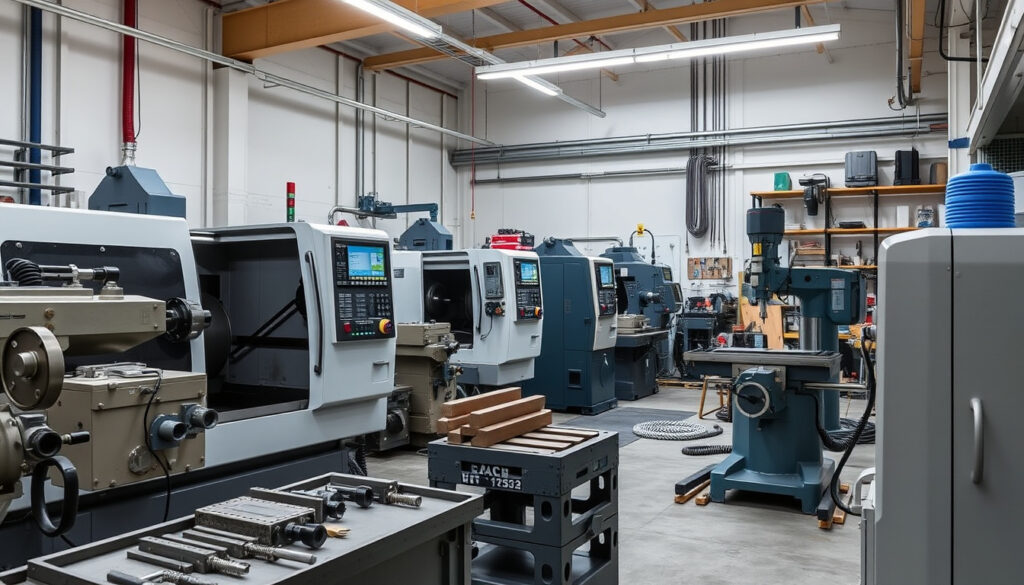
Machine shops are the behind-the-scenes workshops where raw metal, plastic, or composite materials get turned into finished parts through cutting, drilling, milling, turning, and grinding. They handle everything from one-off custom repairs to high-volume production runs, and the equipment they use largely determines what they can do and how much they’ll charge.
A buyer looking for a single prototype should call a job shop, but a manufacturer needing 5,000 identical parts should target a production shop with CNC automation — the wrong shop type will either overcharge or underdeliver.
What do people do in a machine shop?
The daily work in a machine shop revolves around three core activities: interpreting technical drawings (blueprints or CAD files), setting up and operating machines, and inspecting finished parts for dimensional accuracy. According to the Bureau of Labor Statistics (U.S. government labor data), machinists in the U.S. set up and operate a variety of computer-controlled and mechanically controlled machine tools to produce precision metal parts. The work splits between programming CNC machines, manually operating lathes and mills, and performing quality checks with micrometers and coordinate-measuring machines.
What are the 5 machine shop equipment?
- Lathes — rotate the workpiece against cutting tools to create cylindrical parts
- Milling machines — use rotating cutters to remove material from stationary workpieces
- Drill presses — create precise holes
- Grinders — finish surfaces to tight tolerances
- CNC machining centers — automated multi-axis machines that combine several operations
Rapid Protos (prototyping cost specialists) notes that shops with 5-axis CNC centers can produce complex geometries in a single setup, reducing lead times but commanding premium rates of $100–$200+ per hour.
Do and don’ts in machine shop
- Do: provide clear engineering drawings with tolerances and material specifications
- Do: ask about setup fees and minimum order quantities before approving a quote
- Don’t: assume the hourly rate includes materials — most shops bill material separately
- Don’t: request rush delivery without asking about the premium; expedited costs can add 50–100%
The Occupational Safety and Health Administration (U.S. workplace safety regulator) requires proper machine guarding and eye protection — a shop that skips safety protocols is likely cutting corners on precision too.
How much does a machine shop charge per hour?
This is the question most searchers are really asking with “machine shop near me,” and the answer is more layered than a single number. Published 2026 guides from multiple sources show rates ranging from $50 per hour for a basic 3-axis job to $200+ per hour for a 5-axis aerospace part. The cheapest quoted rate often hides setup fees, programming costs, and material markups.
Three rates, one pattern: the machine type determines the floor, but job complexity sets the ceiling.
| Machine type | Hourly rate range | Source |
|---|---|---|
| 3-axis CNC milling | $50–$85 | The Machine Daily (2026 cost guide) |
| 4-axis CNC milling | $75–$105 | The Machine Daily (2026 cost guide) |
| 5-axis CNC milling | $100–$200+ | Rapid Protos (prototyping cost specialists) |
| Mill-turn (live tooling) | $120–$150 | The Machine Daily (2026 cost guide) |
What is the cost per machine hour?
The “cost per machine hour” that shops quote is not the same as what you’ll pay. CNC Optimization (cost estimation specialists) explains that fully loaded shop rates include operator wages, machine depreciation, floor space, utilities, tooling, and profit margin. A shop quoting $75/hour for a 3-axis mill may be barely breaking even, while one quoting $125/hour has built in maintenance and quality inspection costs. That $50 spread often determines whether your part arrives within tolerance.
Setup fees add $150–$250 per unique operation, and minimum order values typically fall between $250 and $500. A single prototype costing $300 to machine might carry a $200 setup fee, making the effective rate far higher than the advertised hourly figure.
The takeaway: always ask for an all-in quote to avoid surprises.
What are the benefits of using a machine shop?
Local machine shops offer advantages that online manufacturing platforms and overseas suppliers cannot match — speed, personal communication, and the ability to iterate quickly on prototypes. These benefits come with trade-offs that you should weigh before signing a purchase order.
Upsides
- Precision and accuracy: CNC machines hold tolerances within ±0.005 inches as standard, and high-end shops can achieve ±0.001 inches (CNC Optimization (cost estimation specialists))
- Ability to produce complex parts: 5-axis machines can create undercuts, compound angles, and organic shapes in one setup
- Time savings for prototypes: Local shops can turn designs into physical parts in days, not weeks — a critical advantage for R&D teams
- Access to specialized equipment: Engine block shops and medical-grade facilities offer expertise that general shops lack
Downsides
- Higher per-unit cost for volume: Overseas CNC shops may undercut local rates by 40–60% for large production runs
- Limited capacity: A small shop with one or two CNC machines may not handle large orders quickly
- Hidden fees: Setup, programming, material sourcing, and inspection can add 30–50% to the quoted hourly total
- Inconsistent quality across shops: Not all shops have the same calibration standards or certification levels
The trade-off: for a prototype or a low-volume custom run, a local machine shop is almost always faster and more reliable than an overseas supplier. For production quantities above 1,000 units, the cost gap widens and offshore options become competitive.
What is the typical turnaround time for a machine shop?
Turnaround time is the second-biggest cost driver after complexity. A simple aluminum bracket that needs only 3-axis milling might ship in one week, while a titanium medical implant requiring 5-axis machining, multiple inspections, and surface finishing could stretch to six weeks or more.
Factors affecting turnaround time
Turnaround time depends on several variables:
| Factor | Impact on lead time | Example |
|---|---|---|
| Part complexity | Simple: 1–2 weeks; complex: 4–6 weeks | A flat plate vs. a 5-axis turbine blade |
| Material availability | Standard materials (aluminum, steel): in stock; specialty alloys: 1–3 week sourcing delay | 6061 aluminum vs. Inconel 718 |
| Shop workload | Busy season (Q4) adds 1–2 weeks; slow season may reduce it | December vs. February lead times |
| Quality inspection requirements | First-article inspection adds 2–5 days | Aerospace vs. non-critical parts |
JCAD USA (machining cost consultants) notes that prototyping with CNC milling typically costs $500–$2,000+ depending on part complexity and volume — and expedited prototypes can be delivered in 3–5 business days at a 50–100% premium. The catch: rush jobs push to the front of the queue only if the shop has machine time available, which is never guaranteed.
What qualifications do you need to work in a machine shop?
For the person searching “machine shop near me,” understanding machinist qualifications is useful for two reasons: it helps you judge a shop’s capability, and it gives context to the rates you’re quoted. A shop staffed by certified CNC programmers with 10+ years of experience will charge more than one hiring entry-level operators — and you generally get what you pay for.
Can you make 100k as a machinist?
Yes, but it requires specialization and often overtime. The Bureau of Labor Statistics (U.S. government labor data) reports that the median annual wage for machinists in the U.S. was approximately $47,000 in 2023. The top 10% earned over $69,000. Experienced CNC programmers and tool and die makers in high-demand industries like aerospace and medical devices can exceed $100,000 with overtime and shift differentials, according to JCAD USA (machining cost consultants).
The pattern: a shop whose lead machinist earns $100k+ is likely to have higher shop rates but also lower error rates and tighter tolerances than a shop staffed by entry-level operators.
“True shop rate should include overhead, not just machine time. The shop quoting $50 an hour might be covering only the operator and the power bill — not the building lease, insurance, or quality inspection.”
— Industry consultant quoted in “Stop Looking for That 10-Cent Part”
“We focus on repair and maintenance, not mass production. A shop that does both often compromises on turnaround.”
— Senior machinist, BTA Machine Shop
For anyone searching “machine shop near me” in the U.S., the choice between a low advertised rate and a higher shop rate with transparent pricing is the most consequential decision. The cheap rate often hides setup fees, material markups, and rush surcharges that can double the final invoice — while a higher but all-inclusive rate from a reputable shop gives you a predictable budget and a part that meets print specifications.
mechhub.in, openspindle.com, blog.jvmfgco.com, hotean.com, helanwangsf.com, machinetoolsearch.com, jcadusa.com
If you’re considering a full engine rebuild, our detailed guide on engine rebuild costs and turnaround provides cost and turnaround specifics.
Frequently asked questions
What is a machine shop?
A machine shop is a facility where metal, plastic, or composite materials are cut, drilled, milled, turned, and ground into finished parts using manual and computer-controlled (CNC) equipment.
How do I choose a machine shop near me?
Look for shops with clear online pricing guides, customer reviews referencing quality and turnaround, and certifications like ISO 9001. Request a quote that itemizes setup fees, material costs, and inspection charges separately.
What materials can a machine shop work with?
Most shops handle steel, aluminum, brass, copper, plastics (nylon, Delrin, acrylic), and titanium. Specialty shops may also work with Inconel, Hastelloy, and composite materials. Always confirm material availability before quoting.
What is CNC machining?
CNC (Computer Numerical Control) machining uses pre-programmed computer software to control machine tools like lathes, mills, routers, and grinders. It enables high-precision, repeatable production of complex parts.
Do machine shops offer design services?
Some full-service shops offer CAD/CAM design and engineering support, often at an additional hourly rate or a flat project fee. Smaller job shops typically require you to provide a complete engineering drawing or 3D model.
Can a machine shop fix a broken custom part?
Yes, many shops specialize in repair and restoration — including welding, re-machining worn surfaces, and fabricating replacement components. Engine block and heavy equipment shops are particularly common for this work.
What should I bring when visiting a machine shop?
Bring a detailed engineering drawing or CAD file with specified tolerances, material preferences, and finish requirements. If possible, bring the broken or original part for reference. A clear scope of work helps the shop give an accurate quote.
Are rush orders available? How much extra do they cost?
Most shops offer expedited service for a premium of 50–100% above standard rates, depending on workload and complexity. Rush orders are typically reserved for simple parts during periods of low shop utilization.
More related posts
 Need for Speed Movie: Flop, Sequel, Where to Watch
 Quack AI On-Chain: What It Is, Price, How to Buy & More
 Academy Sports Credit Card: Apply, Rewards & Payments Guide
 Get 67 in Steal a Brainrot: Drop Rate, Crafting, Festive Code
 Pelvic Floor Physical Therapy Ireland: Exercises & What to Expect
 Teen Mom: The Next Chapter: Where to Watch & Seasons
 What Is Prompt Engineering – Techniques and Examples Guide
 What Is a Function in Math? Definition & Examples