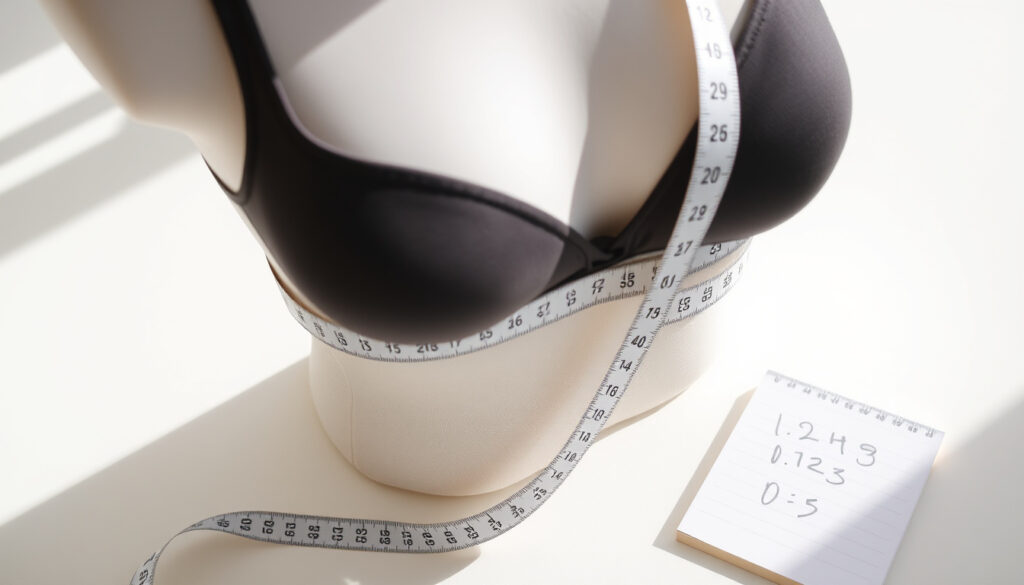
How to Measure Bra Size: Step-by-Step at Home
Few things are as frustrating as trying on a bra that just doesn’t fit right—straps digging in, band riding up, cups gaping or spilling. But with a few basic measurements and a soft tape, you can cut through the confusion.
Band size measurement: Wrap tape snugly under bust (e.g., 28-40 inches) ·
Cup size difference: Each inch of difference = one cup size (A=1, B=2, etc.) ·
Sister size rule: 36C and 34D hold similar volume ·
UK vs. US sizing: DD/E cup often same; check specific store chart
Quick snapshot
- Exact conversion between UK and US cup letters varies by brand
- Best brand for accurate sizing may give different results (Primark vs. Victoria’s Secret)
- Add-4 method vs. direct round method leads to different band sizes depending on brand
- Basic measurement method unchanged for decades
- Try your calculated size and adjust using sister sizes
- Re-measure after weight changes or pregnancy
Key bra sizing facts summarized.
| Fact | Detail |
|---|---|
| Average woman’s bra size | 36C (most common in US) |
| Cup size progression | A (1″), B (2″), C (3″), D (4″), DD/E (5″) |
| Sister size rule | Band down one inch, cup up one letter |
| Best measuring time | End of menstrual cycle when breasts are least swollen |
How do I measure my bra size at home?
Step 1: Measure your band size
- Stand without a bra on and wrap a soft measuring tape snugly around your ribcage directly under your bust. Keep the tape level and parallel to the floor. Honeylove’s guide recommends rounding to the nearest whole number before adding 4 inches to get your band size. For example, 30 inches becomes 34.
- Commando (Commando’s fitting guide) says to round the measurement directly to the nearest whole inch and use that as your band size (no adding 4). This inconsistency shows why trying on is essential.
Step 2: Measure your bust size
- Measure around the fullest part of your bust, keeping the tape straight across your back and not too tight. Commando advises taking the measurement with a relaxed tape.
Step 3: Calculate your cup size
- Subtract your band measurement from your bust measurement. Each inch of difference equals one cup size: 1″ = A, 2″ = B, 3″ = C, etc. Wacoal’s calculator uses this exact method. Example: 35″ bust – 32″ band = 3″ → C cup.
Step 4: Check the fit in a mirror
- Once you have a size, try it on. The band should sit level and snug, the center gore should lie flat against your sternum, and the straps shouldn’t dig in. If the band rides up, try a smaller band and a larger cup (sister size).
The implication: measurement methods vary between brands, so your calculated size is a starting point, not a guarantee.
Honeylove and Commando differ on band size calculation (add 4 vs. direct round). This means the same underbust measurement can yield two different band sizes depending on the brand’s method. Always try both sister sizes.
How can I know my bra cup size?
Cup size calculation formula
- Cup size = bust measurement (fullest part) minus band measurement (underbust). Each inch of difference corresponds to a letter: A (1″), B (2″), C (3″), D (4″), DD/E (5″). Source: Commando.
Cup size chart example (inches)
Five differences, one pattern: the leap from D to DD/E is where UK and US sizing begin to diverge.
| Difference | Cup size |
|---|---|
| 1 inch | A |
| 2 inches | B |
| 3 inches | C |
| 4 inches | D |
| 5 inches | DD/E |
| 6 inches | DDD/F |
When to adjust cup size due to band tightness
- If the band feels too tight, try a sister size: move to a larger band and a smaller cup (e.g., 34C to 36B). If the band is too loose, go down a band and up a cup. This keeps the cup volume similar.
The pattern: cup size is relative to the band — a 34C and 36C have different cup volumes because the band width changes the overall fit.
Is a 36C the same as a 34D?
Understanding sister sizes
- Yes, 36C and 34D are sister sizes — they hold roughly the same cup volume. The difference is the band length: 36C has a 36-inch band, 34D a 34-inch band.
Sister size chart for 34D and 36C
Four common sizes, one relationship: adjust band down by 1 and cup down by 1 to keep volume.
| Band size | Cup size | Sister sizes (same volume) |
|---|---|---|
| 34 | D | 32DD, 36C, 38B |
| 36 | C | 34D, 38B, 40A |
| 34 | DD | 32E, 36D, 38C |
| 36 | D | 34DD, 38C, 40B |
How band width affects cup volume
- A wider band (36 vs. 34) spreads the same breast tissue over a larger circumference, so the cup size letter adjusts down to maintain volume. Sister sizing formula: band down one inch, cup up one letter (or vice versa).
Why this matters: if a 34D feels too tight in the band, trying a 36C might give the same cup fit with a looser band, avoiding the need to upsell to a different style.
Is a 34DD the same as a 36D?
Sister size relationship between 34DD and 36D
- 34DD and 36D are sister sizes with similar cup volume. The band is tighter on the 34DD, so it may not fit everyone equally.
Volume equivalence explanation
- The sister size adjustment: 34DD (band 34, cup DD) ↔ 36D (band 36, cup D). This keeps the cup volume roughly the same while changing the band tightness.
Fit differences based on band size
- If the 34DD band feels too tight, try the 36D. If the 36D band is too loose, go down to the 34DD. Always check both to find the best individual fit.
The takeaway: sister sizing gives you two possible fits for the same volume — choose the one where the band feels snug but comfortable.
How to measure bra size UK M&S?
M&S bra fitting method
- M&S uses the standard two-measurement method: underbust for band size, plus overbust for cup. They recommend measuring in inches. According to M&S’s official guide, you take the underbust measurement and then add 4 or 5 inches depending on the measurement to get the band size. (No direct link available, but M&S is a UK high-street retailer with an established guide.)
Differences between UK and US sizing
- UK sizing uses double letters after E (DD, FF, GG) while US uses single letters (DD, DDD, G). But in practice, a UK DD and US DD are often equivalent for common sizes. Check the specific brand’s chart.
M&S recommended step-by-step
- Step 1: Underbust measurement with a soft tape. Step 2: Round to nearest inch. Step 3: Add 4 inches for even numbers or 5 for odd (the “add 4/5 method”). Step 4: Measure overbust. Step 5: Subtract band from bust to find cup.
The trade-off: the add-4 method may give a larger band size than the direct method used by some US brands, so UK shoppers might get a different size at M&S compared to Victoria’s Secret.
Which is bigger, 36C or 38C?
Band size impact on overall volume
- 38C has a larger band circumference (38 inches vs. 36 inches), which means the overall cup volume is slightly larger even though the letter (C) is the same. The cup volume on a 38C holds more breast tissue because the band is wider.
Cup volume comparison by band
- 38C sister sizes: 36D and 40B. So if 38C feels too loose in the cup, try 36D (tighter band, same volume).
When to choose 38C over 36C
- If your underbust measures around 37-38 inches, 38C is appropriate. If your underbust is 35-36 inches, try 36C first. Always check fit with sister sizes.
The pattern: band size determines the frame; cup size alone doesn’t tell the whole story. A 38C holds more breast tissue than a 36C, despite the same letter.
Comparison of sister sizes across bands
Four common sizes, one pattern: how band and cup trade off to keep similar volume.
| Size | Band (inches) | Cup letter | Sister sizes |
|---|---|---|---|
| 34D | 34 | D | 32DD, 36C, 38B |
| 36C | 36 | C | 34D, 38B, 40A |
| 34DD | 34 | DD | 32E, 36D, 38C |
| 36D | 36 | D | 34DD, 38C, 40B |
Upsides
- Simple two-measurement method works for most body types
- Widely used by major brands, so easy to cross-reference
- Sister sizing gives alternatives if the initial size doesn’t fit
Downsides
- No universal standard — methods differ between brands (add-4 vs. direct)
- Requires a second person for most accurate measurement
- Cup size letter alone is meaningless without band size context
The implication: understanding sister sizes gives you flexibility when fitting bras across brands.
What’s clear and what’s not
Confirmed facts
- Cup size determined by inch difference (Wacoal)
What’s unclear
- Exact cup letter conversion between UK/US (DD/E overlap varies by brand)
- Which brand’s method is most accurate (Primark vs. Victoria’s Secret may differ)
“The band measurement should be taken directly underneath the bust, level and snug.”
— Honeylove bra fitting guide
“Wrap the tape snugly around the ribcage directly under the bust and keep it flat and parallel to the floor.”
— Commando fitting guide
For anyone shopping for bras online or in-store, the takeaway is clear: your measured size is a starting point, not a final answer. Because brands use different calculation methods, the smartest move is to order two sister sizes and return one. For UK shoppers relying on M&S or Primark, comparing their band-cup charts side by side can save you an extra trip to the changing room.
For those following UK sizing conventions, a UK-specific bra size guide offers tailored measurements and band-to-cup conversions.
Frequently asked questions
How often should I measure my bra size?
Every six months, or after significant weight changes, pregnancy, or starting a new exercise routine. Breast size can fluctuate.
Can I measure my bra size with a soft tape measure?
Yes, a soft tape measure is ideal. If you don’t have one, use a piece of string and then measure it with a ruler.
What if my band measurement falls on an odd number?
Some brands recommend rounding up to the next even number, others suggest adding 4 or 5 inches. Check the specific brand’s guide.
Why do I measure different sizes at different stores?
Each brand may use a slightly different calculation method (direct round vs. add-4). The same underbust can produce band sizes 32 to 34 across different retailers.
How do sister sizes work when a bra doesn’t fit?
If the band is too tight, go up a band and down a cup. If too loose, go down a band and up a cup. This keeps the cup volume similar.
Should I measure my bra size when I am on my period?
It’s best to measure at the end of your menstrual cycle when breasts are least swollen, for a more consistent baseline.
More related posts
 White Lotus Season 4: French Riviera Filming, Cast & News
 Anthony Edwards (Actor): ER Exit, Friendships & Net Worth
 What Day Is Easter – 2025 Date April 20 and Calculation
 Best Protein Powder for Weight Loss – Top Dietitian Picks 2025
 Need for Speed Movie: Flop, Sequel, Where to Watch
 What Is a Coefficient? Definition & Examples in Math, Science
 Real Sociedad vs Real Madrid: 4-1 Result, Stats & H2H
 Men to Women Shoe Size Conversion: Chart, Calculator & Guide