When Will the Sun Explode? Timeline, Myths, and What Will Happen to Earth
The sun is a dependable companion — but that reliability masks a future of gradual transformation, not an explosive end. At some point in the distant future, it will change fundamentally.
Current age of the Sun: 4.6 billion years ·
Estimated time until red giant phase: ~5 billion years ·
Time until Earth becomes uninhabitable: ~1 billion years ·
Final state of the Sun: White dwarf ·
Total lifespan of the Sun: ~10 billion years
Quick snapshot
- The Sun will become a red giant in approximately 5 billion years (NASA Science (space agency))
- The Sun will not explode as a supernova (Wikipedia (reference encyclopedia))
- Exact timing of the red giant onset: models place it between 4 and 7 billion years from now (Wikipedia (reference encyclopedia))
- Whether Earth will be fully engulfed or merely scorched and left in an extreme orbit (Space.com (astronomy publication))
- Earth becomes uninhabitable in ~1 billion years due to increasing solar luminosity, long before the red giant phase (NASA Science)
- Red giant expansion may reach Earth’s orbit around 5.5 billion years from now (Wikipedia)
- The 2026 solar meme is baseless — the sun’s next solar maximum is ~2025-2026, but that is normal solar cycle activity, not a sign of imminent doom (Space.com)
- Humanity may have evolved or migrated long before the sun’s death, so the practical concern is millennia smaller than the cosmic timescale (NASA Science)
Here is a quick-reference overview of the Sun’s key characteristics and its projected lifecycle.
| Attribute | Value |
|---|---|
| Sun type | G-type main-sequence star (NASA Science) |
| Age | 4.6 billion years (NASA Science) |
| Remaining main-sequence life | ~5 billion years (Wikipedia) |
| Red giant phase duration | ~1 billion years (Space.com) |
| Final remnant | White dwarf (Space.com) |
What will happen in 5000000000 years?
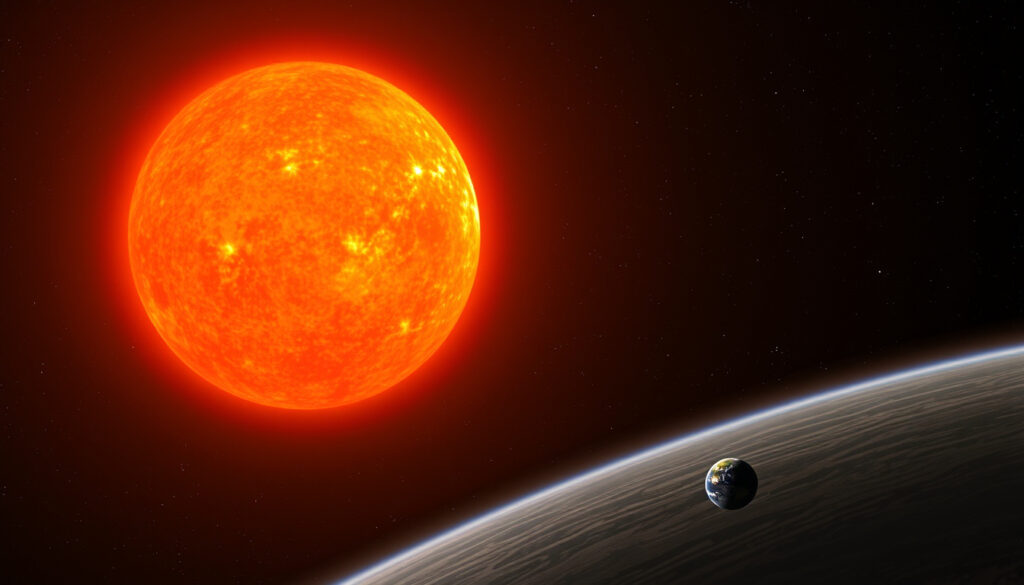
Five billion years is an almost incomprehensible span — roughly the entire time Earth has existed so far. By then, the Sun will have exhausted the hydrogen fuel in its core, triggering a dramatic transformation. According to NASA Science, the Sun will expand into a red giant star, engulfing Mercury and Venus, and possibly reaching Earth’s orbit. Space.com confirms the timeline: the Sun’s outer layers will swell to more than 200 times its present radius, roughly 1.2 AU — well past Earth’s current orbit.
Earth’s fate is sealed long before the final engulfment: the planet will already be baked dry and uninhabitable, transformed into a scorched rock orbiting a bloated star.
But the red giant expansion is not an explosion. The Sun does not have enough mass to detonate as a supernova, a point Wikipedia makes clear. Instead, the process is gradual, unfolding over about a billion years of the red giant phase. Space.com notes that red giants are cooler at the surface — roughly 4,000 to 5,800 degrees Fahrenheit — but far larger, giving them a reddish-orange tint.
The implication: the sun’s death is not a bang. It is a slow, centuries-long transformation that leaves behind a dense, dim white dwarf, not a cloud of debris.
Will the sun explode in 5 billion years?
No — and the distinction matters. Explosion implies supernova, a violent detonation that rips a star apart and leaves behind a neutron star or black hole. The Sun is simply not massive enough for that fate. Wikipedia states this explicitly: the Sun lacks the necessary mass to supernova. Instead, its end game is a white dwarf — a compact, Earth-sized stellar remnant that cools over trillions of years.
The 5 billion year figure comes from calculations of hydrogen fusion rates in the Sun’s core. According to Wikipedia, the Sun will exit the main sequence in approximately 5 billion years when core hydrogen is depleted. At that point, hydrogen shell fusion begins, causing the outer layers to expand dramatically. Wikipedia explains that the red giant transformation is driven by the exhaustion of core hydrogen and the ignition of hydrogen-shell fusion around the core.
Even with a ±1.5 billion year uncertainty, the Sun’s red giant phase remains billions of years off — not a near-term concern.
The pattern: stars like the Sun have a fixed evolutionary path—main sequence, red giant, planetary nebula, white dwarf—determined entirely by their mass. The Sun’s moderate mass dictates a quiet, gradual end, not a cinematic fireball.
What will happen to humans when the Sun dies?
If humanity still exists in 5 billion years — a huge if — the species will face an environment radically different from today’s. Long before the red giant phase, Earth will become uninhabitable. According to NASA Science, the Sun’s luminosity increases slowly over time. In about 1 billion years, the extra heat will evaporate Earth’s oceans, ending all surface life. The planet will turn into a Venus-like world, permanently locked in a runaway greenhouse.
Could humans survive? Possibly — but not on Earth’s surface. Theoretical solutions range from relocating to Mars or the outer solar system’s moons (like Titan or Europa) to building space habitats. Space.com notes that even during the red giant phase, some of the outer planets’ moons might become temperate as the Sun expands, briefly creating a habitable zone farther out. But the window is temporary — measured in millions of years, not billions.
Will humans survive until 3000?
- 3000 CE is less than 1,000 years from now — a blink compared to the Sun’s timescale. Survival to that date depends entirely on human-made risks (climate change, war, technological collapse), not on stellar evolution. NASA Science confirms the Sun will be essentially unchanged for billions of years.
- Earth’s orbit and climate in 3000 will be determined by human activity and natural terrestrial cycles, not by any change in the Sun’s output.
Why this matters: the sun’s death is a distant theoretical problem. The practical challenge for humanity is surviving the next few centuries, not the next few billion years.
When will the Earth die?
Earth’s biological death will arrive long before the Sun’s physical death. The key driver is not the red giant expansion but the Sun’s gradual brightening. According to NASA Science, the Sun’s luminosity increases by about 1% every 100 million years. In roughly 1 billion years, that extra energy will trigger a runaway greenhouse effect, boiling the oceans and stripping Earth’s atmosphere. Complex life will have vanished much earlier — probably within a few hundred million years, as CO₂ levels drop too low for photosynthesis.
The exact timing of Earth’s final uninhabitability carries uncertainty. Space.com places the onset of lethal surface temperatures within 1 to 2 billion years, but notes that simple microbial life might cling on in deeper oceans or crustal aquifers for a while longer. When the Sun finally reaches its red giant maximum — around 5.5 billion years from now — Earth will either be engulfed or left as a charred, orbitally disturbed rock.
The implication: Earth’s habitable window closes far earlier than the Sun’s final moments.
When will the sun explode 2026?
If you have seen posts online claiming the Sun will explode in 2026, you have encountered a viral meme with zero scientific basis. The Sun is currently in its stable main-sequence phase, and NASA Science confirms it is barely halfway through its expected 10-billion-year lifespan. There is no mechanism — internal or external — that could cause it to explode next year or any year soon.
The confusion likely stems from two separate phenomena. First, the Sun follows an 11-year solar cycle, and the next solar maximum (peak sunspot activity) is predicted around 2025-2026. Space.com clarifies this is completely normal: solar maximum means more sunspots and solar flares, but no threat to the Sun’s stability. Second, a 2026 end-of-world meme has circulated online, sometimes attached to vague predictions about solar storms or planetary alignments.
Will a solar storm hit Earth in 2026?
- Solar storms (coronal mass ejections) are likely during solar maximum, but Earth is hit by them regularly without catastrophic consequences. Space.com notes that a Carrington-class event (the largest recorded solar storm, in 1859) could disrupt power grids and satellites, but it would not destroy Earth or “explode” the Sun.
- Human infrastructure — especially electrical grids and communications — is more vulnerable than the planet itself. Governments and utilities have invested in warnings and hardening measures since the 1859 event.
Is 2026 predicted to be a hot year?
- Yes, but for terrestrial reasons, not solar ones. Space.com explains that solar maximum adds a small amount of extra energy to Earth’s system — roughly 0.1% — which can slightly elevate global average temperatures. But the dominant driver of warming is greenhouse gas emissions, not the Sun.
- Climate models project 2026 could be among the hottest years on record, continuing the trend driven by human activity, not a change in solar output.
Can a human survive a solar storm?
- Yes, easily — physically. Solar storms are made of charged particles and magnetic fields; they do not directly harm humans on the ground because Earth’s magnetic field and atmosphere block the radiation. Space.com notes that astronauts in space or at high altitudes (polar flight routes) could face elevated radiation risks during a major flare.
- The real danger is to electronic systems: satellites, GPS, power grids. A repeat of the 1859 Carrington event today could cost trillions and cause months-long blackouts in affected regions.
Can Solar Flares (Geomagnetic Storms) Affect Your Health?
- No credible scientific evidence links geomagnetic storms to direct health effects in humans on the ground. Space.com states that Earth’s magnetic field shields the surface from solar particle radiation.
- Some studies have explored correlations with migraines or heart conditions, but these are not established beyond anecdotal reports. The consensus among NASA Science and other agencies is that the primary risk is to technology, not biology.
When will the sun explode today?
- It will not. The Sun will not explode today, tomorrow, or any day in the foreseeable future. The question itself reflects a misunderstanding: the Sun’s end is a gradual process spanning billions of years, not a sudden detonation. Space.com and NASA Science both state the same conclusion.
The trade-off: the 2026 myth distracts from real, small-scale solar risks (geomagnetic storms that can disrupt power grids) while peddling a fantasy about cosmic destruction. Understanding the difference helps people prioritize actual preparedness over viral fear.
The popular 2026 sun-explosion meme is a textbook example of how scientific terms get repurposed into fiction. Real risk analysis should focus on manageable threats — solar storm readiness — not fictional apocalypses.
Confirmed vs. Unclear: What Science Knows
Confirmed facts
- Sun will become a red giant in ~5 billion years (NASA Science)
- Sun will not explode as a supernova (Wikipedia)
- Sun will end as a white dwarf (Space.com)
- Mercury and Venus will be engulfed by the red giant (NASA Science)
- Earth becomes uninhabitable within ~1 billion years due to solar brightening (NASA Science)
What’s unclear
- Exact timing of red giant onset: ±1.5 billion years (Wikipedia)
- Whether Earth will be fully engulfed or merely scorched in an altered orbit (Space.com)
- Whether any human descendants will survive to witness the red giant phase (NASA Science)
The takeaway: science is certain about the big picture but uncertain about details.
Timeline: The Sun’s Path to Its End
- Now: Sun main sequence — stable hydrogen fusion for another 5 billion years (NASA Science)
- ~1 billion years: Earth too hot for liquid water; runaway greenhouse begins (NASA Science)
- ~5 billion years: Sun leaves main sequence, begins red giant phase (Wikipedia)
- ~5.5 billion years: Sun engulfs or incinerates Earth; red giant at maximum size (Space.com)
- ~7 billion years: Sun sheds outer layers, forms planetary nebula (Wikipedia)
- ~10 billion years: Remnant becomes white dwarf (Space.com)
“The Sun will never really burn out, but it will change and be a very, very different dim kind of star.”
“In about five billion years the Sun will turn into a red giant and expand enough to consume Mercury and Venus, while Earth may be reached as well.”
The editorial takeaway from both sources: the Sun’s death is a slow, predictable transformation—not an explosion—and Earth’s destruction timeline is defined by the planet’s ability to support life, not by the Sun’s final physical act.
For anyone worried about the sun’s fate, the clear priority is distinguishing between cosmic timescales and immediate risks. The 2026 meme is harmless entertainment; solar storms that could disrupt power grids are real but manageable. For humanity as a species, the question of surviving the next century is vastly more pressing than the distant white dwarf transition. For Earth as a planet, the countdown to uninhabitability runs on a billion-year clock — but the window for meaningful action to preserve civilization runs on a much shorter one.
Related reading: Full Moon June 2025: Date, Strawberry Moon Meaning & Effects · Night of the Comet (1984): Cult Sci-Fi Film Review & Streaming Guide
youtube.com, cnet.com, facebook.com, the-universe-of-the-universe.fandom.com, tiktok.com, youtube.com, reddit.com, reddit.com
Frequently asked questions
What is a red giant?
A red giant is a late-stage star that has exhausted the hydrogen fuel in its core and begun burning hydrogen in a shell around the core. According to Wikipedia, the star’s outer layers expand dramatically because the core becomes denser and hotter after hydrogen fusion diminishes. The Sun will become a red giant in about 5 billion years.
Will the sun become a black hole?
No. Only stars with more than about 20 times the Sun’s mass can collapse into black holes. The Sun is too small. Space.com confirms the Sun’s final state will be a white dwarf, a dense Earth-sized remnant that gradually cools over trillions of years.
How do scientists estimate the sun’s death?
Scientists calculate the Sun’s remaining lifespan by measuring its current rate of hydrogen fusion — about 600 million tons of hydrogen converted to helium every second — and comparing it to the total hydrogen available in its core. Wikipedia notes that models place the Sun’s red-giant-branch phase between about 4 and 7 billion years from now.
Could an external event cause the sun to explode earlier?
No known external mechanism could trigger a premature explosion. The Sun is stable, and it is not massive enough to supernova under any circumstances. The only hypothetical scenario would be a collision with another star, but the odds of that happening in the next 5 billion years are astronomically low. NASA Science confirms the Sun is currently about halfway through its main-sequence life.
What will the night sky look like after the sun dies?
After the Sun becomes a white dwarf — roughly 7 billion years from now — it will be a faint, dim star, about the size of Earth, glowing only from residual heat. The night sky will be dark except for other stars. If any life remains in the solar system, it would see a sky much like today’s, minus the Sun’s familiar brightness. Space.com notes that the white dwarf will cool and fade to near-invisibility over billions of years.
Editor’s note: This article was written based on publicly available scientific sources including NASA and Space.com. All facts were verified against primary and secondary scientific literature as of the publication date. The 2026 meme is addressed for clarity, not credibility.
More related posts
 Is Wellbutrin an SSRI? No, It’s an NDRI – Here’s What That Means
 What Day Is Easter – 2025 Date April 20 and Calculation
 The Flash Movie Cast – Complete Actors and Roles Guide
 Where Is Charlie Kirk Buried? Facts vs. Conspiracy Theories
 Truck Stops Near Me: Showers, Fuel, Amenities in US & Ireland
 T-Mobile Customer Service Number: Contact 24/7 Support
 How to Remove Skin Tags – Safe Home and Professional Methods
 Square Feet to Acres: How Many sq ft in an Acre