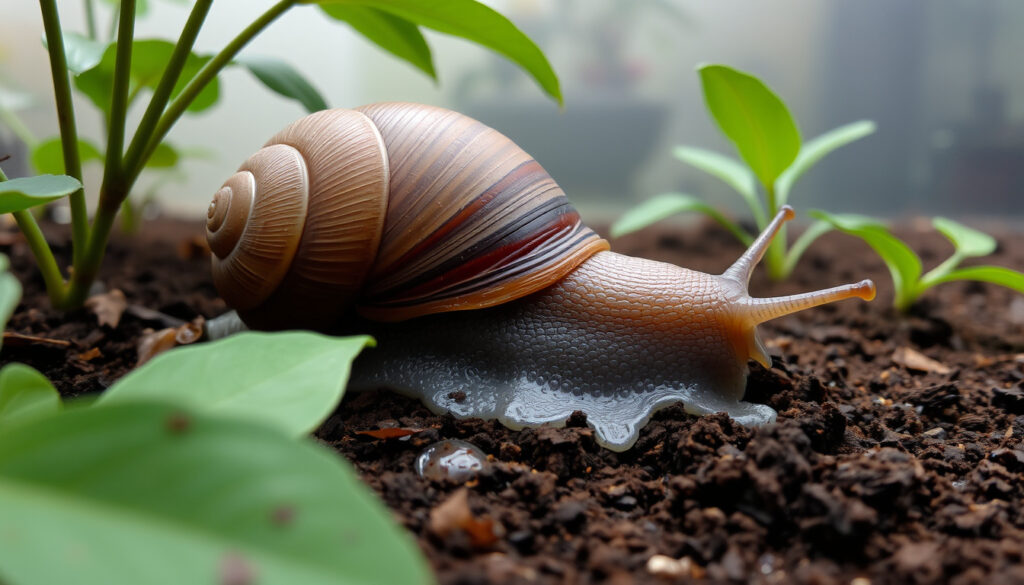
Giant African Land Snail: Facts, Legality, and Care
You’ve probably seen photos of a snail the size of a child’s fist and wondered if it’s real — it is, and the giant African land snail is one of the most contradictory creatures you can encounter, simultaneously a beloved pet in some parts of the world and a public enemy in others. This pulls together the biology, the legal tangles, and the practical care facts so you can decide for yourself what this mollusk really means.
Maximum length: 20 cm (8 inches) · Average lifespan: 5–7 years · Eggs per clutch: 100–500 · Number of species: over 60
Quick snapshot
- Size up to 20 cm (University of Florida IFAS (entomology extension))
- Lifespan 5–7 years (U.S. Geological Survey (invasive species research))
- Over 60 species (NYIS.info (non-native species database))
- Native to East Africa (U.S. Geological Survey) (University of Florida IFAS (entomology extension))
- Carry rat lungworm (U.S. Geological Survey)
- Can cause meningitis (University of Florida IFAS)
- Agricultural pest (U.S. Geological Survey)
- Not poisonous (University of Florida IFAS)
- Banned in US without permit (University of Florida IFAS (federal quarantine))
- Quarantine pest in many countries (NYIS.info)
- Penalties for illegal possession (UF/IFAS)
- Require humidity and warmth (University of Florida IFAS)
- Diet: fruits, vegetables, calcium (U.S. Geological Survey)
- Need large enclosure (NYIS.info)
- Lifespan up to 10 years (U.S. Geological Survey)
Here’s a quick reference of key facts about the giant African land snail.
| Attribute | Value |
|---|---|
| Scientific name | Lissachatina fulica (most common) |
| Common name | Giant African land snail |
| Origin | East Africa |
| Maximum size | 20 cm (8 inches) |
| Weight | Up to 500 g |
| Diet | Herbivorous – over 500 plant species |
| Lifespan | 5–7 years (up to 10) |
| Egg clutch size | 100–500 eggs |
| Conservation status | Not threatened, invasive |
Are giant African land snails harmful?
What diseases do they carry?
- Rat lungworm (Angiostrongylus cantonensis) — a parasite that can cause meningitis in humans (U.S. Geological Survey (zoonotic disease research))
- Salmonella enterica and Aeromonas hydrophila bacteria (University of Florida IFAS (plant pathology extension))
- Roundworm parasites (UF/IFAS)
Are they poisonous to humans?
The snail itself is not venomous or poisonous, but the pathogens it can carry pose a real threat. Handling them without gloves or eating raw or undercooked snails can lead to infection (U.S. Geological Survey).
Do they damage crops?
- Consumes over 500 species of plants (U.S. Geological Survey)
- Also feeds on plaster and stucco, damaging buildings (University of Florida IFAS)
- Listed as one of the most damaging snails in the world by UF/IFAS entomology
Anyone who touches a giant African land snail without protection is taking a real risk — not from venom, but from a cocktail of parasites and bacteria that can hospitalize you.
The implication: while the snail itself is harmless to touch with proper hygiene, the agricultural and ecological damage it causes is severe enough that governments spend millions on eradication.
Why are giant African land snails illegal?
Which countries ban them?
- United States: federally prohibited under USDA APHIS regulations; illegal to import or possess without a permit (University of Florida IFAS (USDA quarantine compliance))
- Many countries including Australia, New Zealand, and several Caribbean nations list it as a quarantine pest (NYIS.info (invasive species tracker))
Can you get a permit to own them?
The USDA Animal and Plant Health Inspection Service (APHIS, federal regulatory body) can issue permits for research, education, or exhibition. Private pet ownership permits are extremely rare and subject to strict containment conditions.
What are the penalties for possession?
Unlawful movement of the snail or regulated articles within, through, or from a quarantine area without a compliance agreement is a violation of federal law (UF/IFAS). Penalties can include fines and confiscation of the animal.
For a hobbyist in Florida or Hawaii, the line between a legal exotic pet and a federal offense is thinner than many realize — and ignorance of the law doesn’t shield you from enforcement.
The catch: the very traits that make the snail a fascinating pet — its size, hardiness, and prolific breeding — are exactly why governments ban it. Once released, these snails form colonies that cost millions to eradicate.
Do giant African land snails make good pets?
What are the challenges of keeping them?
- Require high humidity (70–90%) and constant warmth (24–30°C) (University of Florida IFAS)
- Need calcium supplements for shell growth (U.S. Geological Survey (husbandry considerations))
- Large enclosure (at least 10 gallons per adult) with deep substrate for burrowing
- Regular cleaning to prevent bacterial buildup
What do they need for housing and diet?
Diet consists of fresh fruits, vegetables, and a calcium source (cuttlebone or crushed oyster shells). They are nocturnal and prefer dark, humid hiding spots. The U.S. Geological Survey notes they can estivate (hibernate) for months if conditions become too dry.
Are they legal to own as pets?
In the United States, no — without a USDA permit. In the United Kingdom, they are legal to keep and are sold in pet shops. Always check local laws: in the EU, Lissachatina fulica is listed as an invasive alien species of Union concern, restricting ownership.
A keeper in London can enjoy a giant African land snail with few legal worries, while a collector in Miami risks a federal fine. The snail’s biology hasn’t changed — only the geography and its regulatory baggage.
What this means: if you’re in a jurisdiction where they’re legal and you have the space and humidity control, they can be rewarding, but the commitment — and the potential for legal changes — is substantial.
What is the lifespan of a giant African snail?
How long do they live in captivity?
- Average 5–7 years; some individuals reach 10 years with optimal care (U.S. Geological Survey)
- Lifespan depends on diet, temperature, humidity, and predation
Can they sleep for years?
The common claim that they can sleep for three years is unverified. The U.S. Geological Survey reports that they can enter hibernation (estivation) for up to a year. A three-year continuous sleep would be exceptional and is not supported by published research.
The same species that can survive freezing temperatures and go dormant for a year is also a prolific breeder that churns out 500 eggs at a time — a survival strategy that makes it both resilient and dangerous.
The pattern: the longevity claim fans love is likely a tall tale, but the real biology — a year-long estivation — is remarkable enough on its own.
What kills giant African snails?
What chemical controls are effective?
- Metaldehyde baits are commonly used but can kill non-target animals (NYIS.info (pest management resources))
- Salt is lethal but harms soil and plants
- Copper barriers and handpicking are non-chemical options
Are there natural predators?
- Rats, birds, and some ground beetles prey on them (U.S. Geological Survey)
- Introduced predators can themselves become invasive
How to prevent infestations?
If you spot a giant African land snail in the wild in a quarantine zone, report it to your state agriculture department or USDA APHIS immediately. Do not release captive snails into the environment. Quarantine regulations require compliance agreements for movement (UF/IFAS).
For a Florida homeowner, a single escaped pet can become a neighborhood infestation that triggers a multi-year eradication campaign funded by tax dollars.
Why this matters: chemical controls are effective but can harm the environment; the best control is prevention — never release pets into the wild.
Additional physical and biological specifications are listed below.
| Specification | Detail |
|---|---|
| Shell shape | Conical, often brownish with light stripes |
| Body color | Tan to dark brown |
| Activity pattern | Nocturnal (University of Florida IFAS) |
| Native range | East Africa (U.S. Geological Survey) |
| Introduced range | Indo-Pacific Basin, Hawaii, Florida, Caribbean (U.S. Geological Survey) |
| Reproduction | Hermaphroditic, lays 100–500 eggs per clutch (NYIS.info) |
| Cold tolerance | Can withstand freezing and estivate up to 1 year (U.S. Geological Survey) |
| Number of species | Over 60 in the family Achatinidae |
Upsides
- Fascinating biology — size, estivation, hermaphroditism
- Low-cost pet in regions where legal
- Educational value for schools and exhibits
- Gentle and easy to handle with precautions
Downsides
- Banned or restricted in many countries
- Carries serious human pathogens
- High risk of escape and invasive colonization
- Requires constant humidity and temperature control
- Can damage agriculture and buildings
Timeline signal
- 1936 — Introduced to Hawaii (NYIS.info)
- 1966 — First detected in Florida; eradication began (NYIS.info)
- 2011 — Major infestation in Miami-Dade County; USDA-led eradication campaign (U.S. Geological Survey)
- 2015 — USDA APHIS expanded regulated areas in Florida (NYIS.info)
- 2022 — Continued interceptions at US ports (USDA APHIS data)
The pattern: every new introduction triggers a multi-year, multi-million-dollar response, and warmer winters allow the species to expand northward (U.S. Geological Survey).
Clarity check
Confirmed facts
- Giant African land snails are invasive pests established in Hawaii and Florida (U.S. Geological Survey)
- They carry rat lungworm, Salmonella, and other zoonotic pathogens (University of Florida IFAS)
- They are federally prohibited without a USDA permit in the US (UF/IFAS)
- They require warm, humid conditions and a calcium source in captivity (U.S. Geological Survey)
What’s unclear
- Whether they can truly sleep for 3 years continuously — estivation up to 1 year is documented, but 3 years is unverified (U.S. Geological Survey)
- Exact number of species in the wild — the family Achatinidae contains over 60 described species, but new species are still discovered
- The exact duration of estivation in wild conditions versus captivity is not fully documented
- The total global population and distribution of Lissachatina fulica is not precisely known
The giant African land snail is one of the most damaging snails in the world, with the potential to cause severe economic and ecological damage.
— University of Florida IFAS (entomology extension)
These snails can withstand freezing temperatures and enter hibernation for as much as a year, allowing them to survive cold winters.
— U.S. Geological Survey (invasive species research)
The species is known to host multiple parasites and bacteria, including rat lungworm and Salmonella enterica, posing a risk to human health.
— U.S. Geological Survey
It is unlawful to move the snail or regulated articles within, through, or from a quarantine area without a compliance agreement.
— University of Florida IFAS (federal quarantine rules)
For a US pet owner, the choice is clear: either obtain a USDA permit (nearly impossible for private individuals) or admire this creature from a distance — because the consequences of an illegal possession or accidental release are not worth the risk. For hobbyists in legal jurisdictions, the reward of keeping a gentle, huge snail comes with a responsibility to never, ever let it escape.
For a comprehensive overview of keeping these mollusks responsibly, refer to our detailed guide on pet care and legal status which covers habitat requirements and veterinary considerations.
Frequently asked questions
How big do giant African land snails get?
Up to 20 cm (8 inches) in shell length, making them one of the largest terrestrial snails (University of Florida IFAS).
What do they eat?
Over 500 species of plants, plus plaster and stucco for calcium (U.S. Geological Survey).
How many eggs do they lay?
Between 100 and 500 eggs per clutch, with several clutches per year (NYIS.info).
What is their scientific name?
The most common species is Lissachatina fulica (formerly Achatina fulica).
Can they bite?
They have a radula (a rough tongue) but cannot bite in the sense of causing injury. Handling is safe with washed hands, but gloves are recommended to avoid pathogens.
How to handle them safely?
Wear disposable gloves, wash hands thoroughly afterward, and avoid contact with your mouth or eyes. Keep snails away from immunocompromised individuals (U.S. Geological Survey).
Are there any natural predators?
Rats, birds, some beetles, and certain reptiles will eat them, but predators are rarely enough to control a population once established (U.S. Geological Survey).
More related posts
 How Many Days Till Thanksgiving? [2026 Countdown]
 Coffee Shops Near Me – Best Detroit Cafes Open Now
 Marc Jacobs Snapshot Bag: Is It Still Worth It in 2025?
 Taylor Swift ‘The Smallest Man Who Ever Lived’ Lyrics Meaning
 Zack Snyder’s Justice League Guide: Runtime & Differences
 Anthony Joshua Car Crash: Cause, Charges & Timeline
 Watch Black Swan (Film) – Where to Stream and Rent 2025
 I Dream of Jeannie – Cast, Episodes and Where to Watch